About Composia fidelissima Herrich-Schäffer, 1866
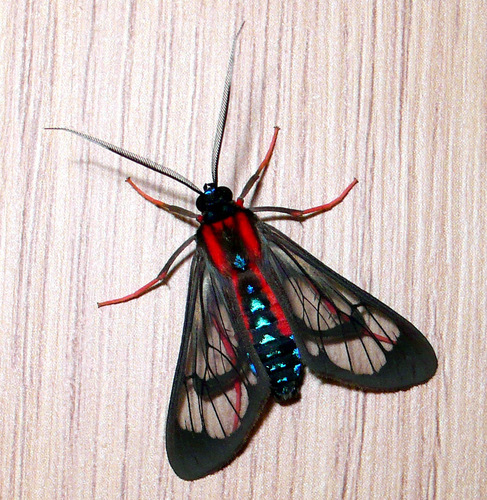
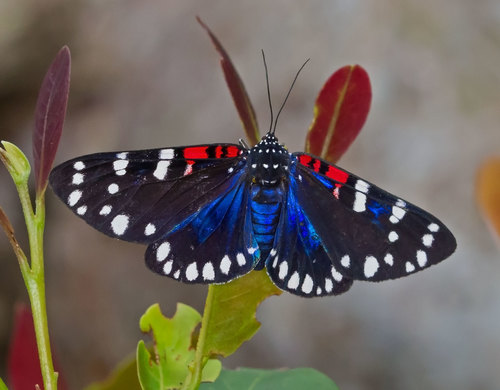
Composia fidelissima, commonly known as the faithful beauty or Uncle Sam moth, is a moth species belonging to the family Erebidae. The species was first formally described by Gottlieb August Wilhelm Herrich-Schäffer in 1866. It occurs naturally in southern Florida and the West Indies, including Cuba. This moth species has distinct wing coloration and patterning: forewings are black with rows of white dots and red coloration along the costal margin. Hindwings have a gradient color transition from blue near the body to black at the outer edge, with white dots along the outer margin. The thorax is black with scattered white speckles matching the forewing patterning, and the abdomen shares the blue color seen on the hindwings. The wingspan of adult Composia fidelissima ranges from 48 to 64 mm. Adults can be found in flight year-round, and they fly during the day. The larvae feed on plants from the species Cynanchum scoparium, multiple species in the genus Canavalia including Canavalia rosea, multiple species in the genus Nerium including Nerium oleander, and multiple species in the genus Echites including Echites umbellatus.