About Commersonia dasyphylla Andrews
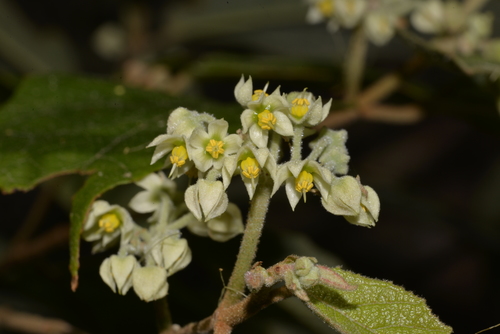
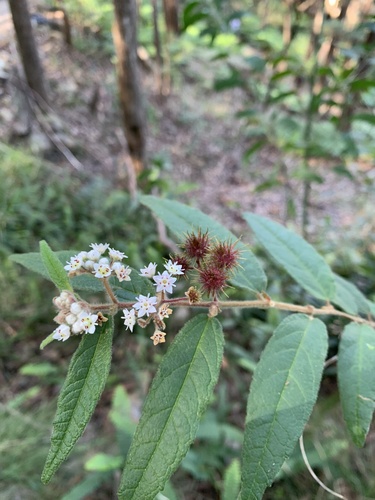
Kerrawang, the common name of Commersonia dasyphylla Andrews, grows as a shrub reaching 1 to 4 meters (3 feet 3 inches to 13 feet 1 inch) in height. Its stems are covered in fine hairs. The dark green leaves are prominently wrinkled, shaped from egg-like to lance-like, 30 to 70 millimeters (1.2 to 2.8 inches) long and 5 to 30 millimeters (0.20 to 1.18 inches) wide, borne on a 2 to 5 millimeter (0.079 to 0.197 inch) long petiole, with toothed or lobed margins. The upper leaf surface is hairy, while the lower surface is densely covered with white, star-shaped hairs. Flowers are arranged in groups of 10 to 21, with each flower around 8 millimeters (0.31 inches) in diameter. Sepals measure 3 to 5.5 millimeters (0.12 to 0.22 inches) long and 1.5 to 3.5 millimeters (0.059 to 0.138 inches) wide, while petals are pinkish or white and about half as long as the sepals. Flowering occurs from September to January, and after flowering, the plant produces hairy brown capsules 5 to 7 millimeters (0.20 to 0.28 inches) in diameter. Commersonia dasyphylla is very similar to C. breviseta and C. rugosa, and is difficult to distinguish from these species without fruit, except by the structure of the star-shaped hairs on the lower leaf surface. This species ranges across eastern Australia, from southeastern Queensland through New South Wales and into eastern Victoria, and it prefers to grow in gullies within forested areas. Flies are likely the most common pollinators of this species, though native bees, beetles, and diurnal moths may also pollinate it. Kerrawang is killed by bushfire and regenerates from seed afterwards. Local Cadigal people of Sydney historically used the plant's fibres to make baskets. Kerrawang is an Australian shrub and should not be confused with the kurrajong, an Australian tree whose bark is used to make twine. It was first cultivated in England in 1819 under the name Rulingia pannosa. Kerrawang is a fast-growing ornamental shrub. It prefers semi-shaded areas with good drainage and mildly acid soil. It seeds readily, and can be easily propagated from either seed or cuttings.