About Commersonia bartramia (L.) Merr.
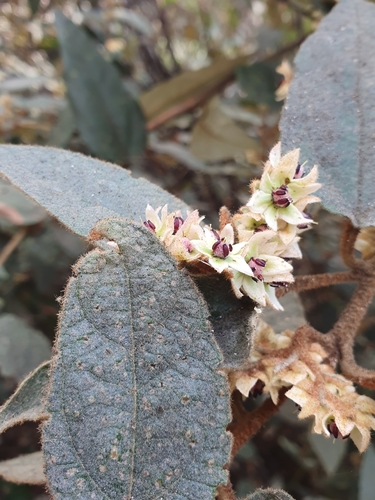
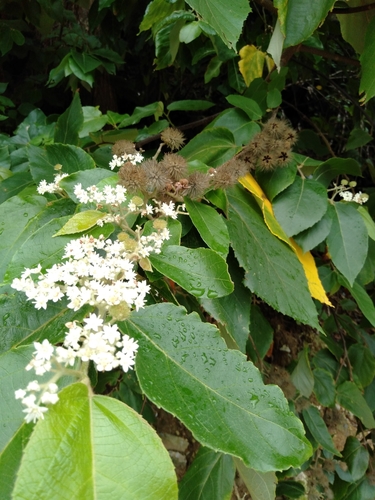
Commersonia bartramia is a species of shrub or tree that typically reaches a maximum height of 25 meters (82 feet). Its trunk can grow up to 50 centimeters (20 inches) in diameter, and sometimes forms buttress roots. Its leaves range from heart-shaped to egg-shaped or broadly egg-shaped, and measure 50–140 millimeters (2.0–5.5 inches) long and 10–20 millimeters (0.39–0.79 inches) wide. Leaves are attached to a densely hairy petiole that is 10–30 millimeters (0.39–1.18 inches) long, with 2–6 millimeter (0.079–0.236 inch) long stipules at the base of the petiole. The leaf tip tapers to a fine point, fine irregular teeth sometimes appear on the lower leaf surface, and the lower leaf surface is much paler than the upper surface. Flowers of this species are arranged in dense heads containing 20 to 100 or more individual flowers, with the entire clustered group measuring 30–100 millimeters (1.2–3.9 inches) long. The flower clusters grow from a peduncle 5–25 millimeters (0.20–0.98 inches) long, and each individual flower sits on a pedicel 2–7 millimeters (0.079–0.276 inches) long. The sepals are joined at the base, with 5 white lobes 1–3 millimeters (0.039–0.118 inches) long. There are five white petals with ligules that are the same length as the sepal lobes, and a single staminode between each pair of stamens. Flowering takes place from October to March, and the fruit produced is a hairy, dark capsule that is 15–25 millimeters (0.59–0.98 inches) long. Commersonia bartramia grows in rainforest, as well as along creeks and gullies near the edges of rainforest. It is a common species in rainforest regrowth areas, and its distribution ranges from southern China southward to the Bellinger River in New South Wales.