About Commelina diffusa Burm.f.
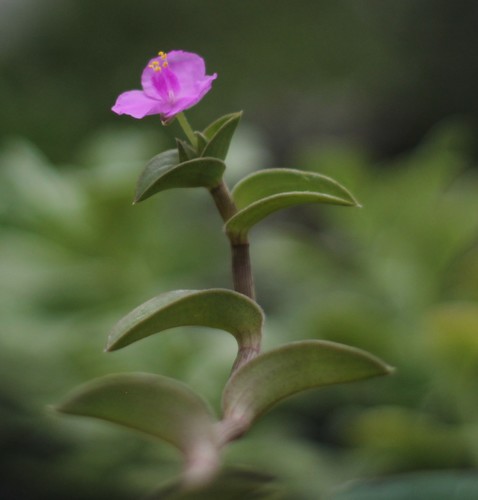
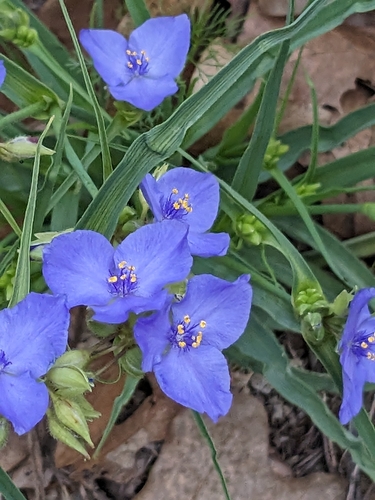
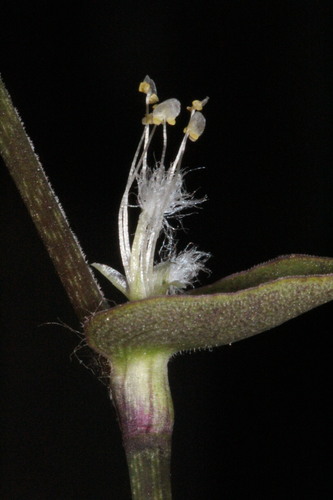
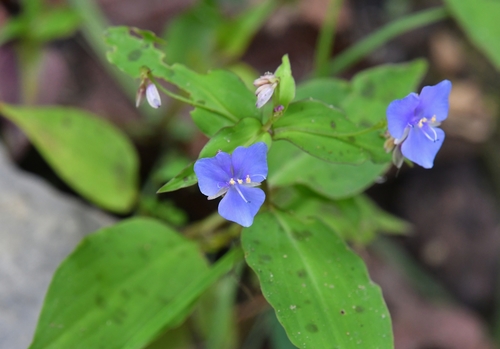
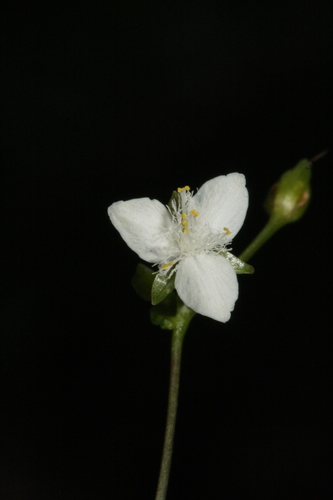
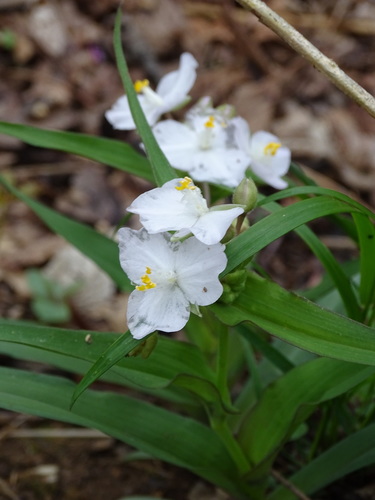
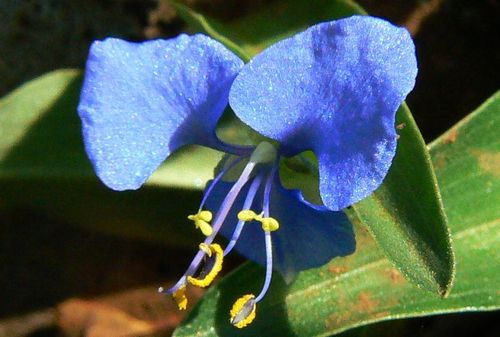
Commelina diffusa Burm.f. is typically an annual herb, though it may grow as a perennial in tropical regions. It spreads diffusely by creeping along the ground, branching heavily, rooting at its nodes, and can reach stem lengths of up to 1 metre. Stem hairiness is variable: stems range from hairless (glabrous) to minutely bristly (hispidulous), and hair can appear either in a line along the stem or across its entire surface. Leaf blades are also quite variable in shape, ranging from lanceolate to ovate, with leaves closest to the plant base tending to be more oblong. Leaf blades measure 3 to 12 cm long by 0.8 to 3 cm wide; populations in North America typically have smaller leaves, which measure 1.5 to 5 cm long by 0.5 to 1.8 cm wide. Leaf tips range from acute to acuminate, and leaf surfaces can be either glabrous or bristly (hispid). Leaves are nearly stalkless (subsessile), with a red-striped leaf sheath covered in bristly hairs. Flowers are arranged in cincinni (scorpioid cymes), a type of monochasium where lateral branches grow alternately on opposite sides of the false axis. There are typically two cincinni per plant: the lower cincinnus holds 2 to 4 flowers, while the upper cincinnus holds one to several flowers. The upper cincinnus is usually exerted outside larger spathes, but may stay included within smaller spathes. The upper cincinnus only bears male flowers, and has a longer peduncle; the lower cincinnus bears bisexual flowers on a shorter peduncle. The pedicels that support individual flowers (and later fruits) are thick, curved, and measure about 3 to 5 mm. Membranous sepals are inconspicuous, at only 3 to 4 mm in length. Petals are blue, and rarely may be lavender. The two upper petals measure 4.2 to 6 mm. The anther connective (the tissue connecting the two halves of the anther) of the central-most stamen has a broad transverse violet band. Spathes are solitary, borne on a peduncle, and typically sickle-shaped (falcate) with a heart-shaped (cordate) to rounded base and acuminate apex. The underside of a spathe may be either glabrous or minutely hispid (hispidulous). Spathes usually measure 0.8 to 2.5 cm long, but can be as short as 0.5 cm or as long as 4 cm; they are typically 0.4 to 1.2 cm wide, and may reach up to 1.4 cm wide. Spathe peduncles are usually 0.5 to 2 cm long, and rarely reach 2.9 cm. Flowering occurs from May to November. Pollen grains are elongated with bilateral symmetry, and are approximately 73 microns in size. The fruit is a three-locule, two-valve capsule that measures 4 to 6.3 mm long by 3 to 4 mm wide, and may be as narrow as 2.1 mm. Capsules contain five brown seeds that measure 2 to 2.8 mm long (rarely up to 3.2 mm) by 1.4 to 1.8 mm wide. Seeds have a deeply net-like (reticulate) surface. The chromosome number of this species is 2n = 30. C. diffusa occurs in tropical and subtropical locations worldwide. It is found across much of southern temperate and subtropical China, specifically in the provinces of Guangdong, southwestern Guangxi, southwestern Guizhou, Hainan, southeastern Tibet, and southeastern Yunnan. Within China, it grows from sea level up to 2,100 metres (6,889 feet), and is typically associated with forests, thickets, stream banks, and open, humid habitats. In Japan, the species has been reported from Yakushima (off Kyūshū) and is present in the Ryukyu Islands, from Amami Ōshima southwards. C. diffusa is originally native to the Caribbean Islands, including most of Puerto Rico and several of the U.S. Virgin Islands (Saint Croix, Saint Thomas, and Tortola). In the West Indies it is a common weed, especially associated with roadsides, moist ditches, and wasteland, growing from sea level to 1,050 metres. In the United States, it typically grows in disturbed locations such as gardens, cultivated areas, and lawns, but can also be found in woods, near creeks, and other moist, partially-shaded areas. It has been introduced to the eastern and southeastern United States, where it occurs from Maryland in the north, west to Missouri, and south to Texas and Florida. It has also been introduced to Hawaii, where it is a common and quickly-spreading weed. The variety C. diffusa var. gigas has been introduced to Florida. The species is commonly observed in California, where it mainly grows as a seasonal perennial: it reseeds each fall and regrows in the spring, generally after periods of rain. It is most commonly found in the Southern Californian counties of Los Angeles, Orange, San Diego, Santa Barbara, and Ventura. Based on this distribution, it is likely also present south of the US-Mexico Border. In China, Commelina diffusa is used as a medicinal herb with fever-reducing (febrifugal) and diuretic effects. A dye for painting can also be obtained from the juice of its petals. In Hawaii, this species (called "honohono grass") was used as medicine to treat deep cuts, while other Hawaiian herbs were used for superficial cuts. According to a work by Bruce French published on papuaweb.org (page 80), young leaf tips of C. diffusa are cooked and eaten in New Guinea.