About Commelina cyanea R.Br.
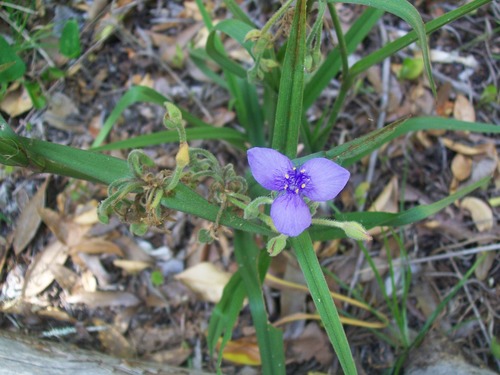
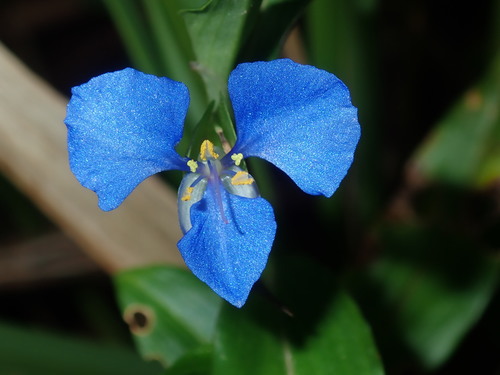
Commelina cyanea R.Br. is a trailing herbaceous perennial plant. Its stems grow along the ground, and readily root at the nodes when the nodes come into contact with soil; all aboveground stems and foliage die back in winter. Its leaves are shaped ovate to narrow-ovate, measuring 2 to 7 cm (0.8 to 2.8 in) long and 5 to 15 mm (0.2 to 0.6 in) wide. Flowering can occur at any time from spring to autumn. The flowers are deep blue and roughly 15 mm (0.6 in) in diameter. After flowering, it produces a seed capsule that holds up to five seeds, each about 3 mm (0.1 in) long. The species is distributed across eastern New South Wales, from Narooma north into Queensland, and also grows naturally on Lord Howe Island. It occurs in wetter shaded areas within forest habitats. Commelina cyanea is pollinated by a range of native bees including Nomia aurantifer, Amegilla pulchra, halictid bees, and colletid bees, as well as syrphid flies of the genus Syritta. Wallabies and rabbits feed on its vegetation, and its plant material may potentially be dispersed by water. Early non-indigenous colonists used the plant’s leaves to alleviate scurvy, a use that gave rise to its common name. With attractive flowers, Commelina cyanea adapts easily to cultivation, and can be grown as a groundcover or in hanging baskets. It is easily propagated from cuttings. It bears a superficial morphological resemblance to the introduced invasive weed wandering Jew (Tradescantia fluminensis). T. fluminensis can be readily distinguished from C. cyanea by its variegated leaves, white flowers, and hairy leaf sheaths, features that C. cyanea does not have. Commelina cyanea itself can sometimes act as a weed in garden settings.