About Commelina communis L.
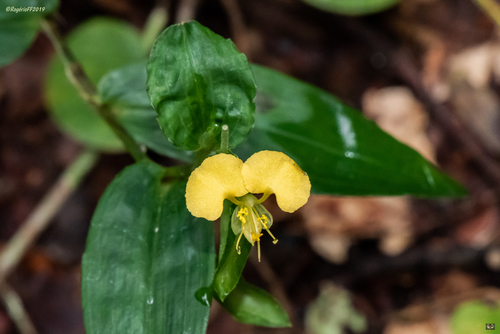
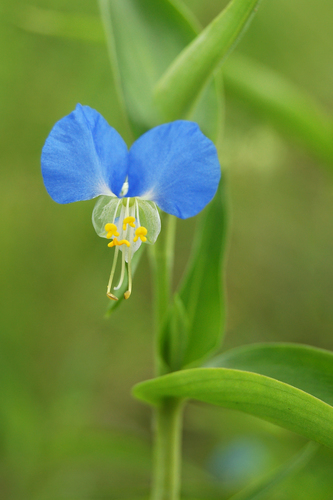
Commelina communis L., commonly known as the Asiatic dayflower, is an annual herb. Its stems are typically decumbent—prostrate at the base and growing erect toward the tips—though some individuals are fully erect. Stems branch diffusely and often root at basal nodes. Stem pubescence (hair coverage) is variable; common patterns include a line of hair connected to the leaf sheath, or hairless (glabrous) bases with fine hairs (puberulent) toward stem tips. Leaves are either stalkless (sessile) or have very small stalks (subpetiolate). Leaf sheaths are cylindrical, sometimes striped red, and usually glabrous, with fine or soft hairs along their margins. Leaf blades range from narrow lance-shaped to ovate-elliptic (between egg-shaped and ellipse-shaped), measuring 3–12 cm long and 1–4 cm wide. Blades can be glabrous or puberulent, with slightly rough (scabrescent) margins. Leaf tips come to a point either quickly (acute) or gradually (acuminate), and leaf bases are uneven (oblique). Flowers grow in inflorescences called cincinni (singular: cincinnus), also known as scorpioid cymes—a type of monochasium with alternately arising lateral branches. Cincinni are subtended by a modified leaf called a spathe. Solitary spathes are usually 1.2–3 cm long (sometimes up to 3.5 cm), and 0.8–1.3 cm tall (sometimes up to 1.8 cm). Uncurved spathes typically have a heart-shaped (cordate) whitish base that contrasts with dark green veins. Spathe margins are hairless, somewhat rough, and unfused all the way to the base. Spathe apices are acute to acuminate, and surfaces can be glabrous, puberulent, or covered in longer shaggier hairs (hirsute–ciliate). Spathes grow on stalks (peduncles) that are 0.8–3.5 cm long, sometimes reaching 5 cm. There are often two cincinni per spathe; the upper (distal) cincinnus may be vestigial. The lower (proximal) cincinnus holds 1 to 4 bisexual flowers and is nearly enclosed by the spathe, while the upper cincinnus holds 1 to 2 male flowers and is about 8 mm long. Individual flowers are subtended by bracteoles that fall off early in development. The pedicels that support flowers and later fruits start erect, then curve once fruit develops, and measure about 3–4 mm. The three sepals are concave, membranous, inconspicuous, and persist after fruit forms. The two lateral sepals are fused at the base, elliptic, glabrous, and measure 4.5–5 mm long by 3–3.7 mm wide. The lower sepal is lanceolate, about 4.5 mm long by 2.2 mm wide. Two upper petals are blue to indigo, while the much smaller lower petal is white. Upper petals measure 9–10 mm long by 8–10 mm wide; the lower petal measures 5–6 mm long by ~6 mm wide. The two upper petals have a ~3 mm long claw and a broadly ovate blade with an acute apex and a cuneate-cordate base. There are three fertile stamens on the lower (anticous) part of the flower, and three infertile stamens (called staminodes) on the upper (posticous) part. Fertile stamens are dimorphic. The lateral pair of fertile stamens have maroon to indigo anthers that are elliptic, ~2 mm long, with arrowhead-shaped (sagittate) bases; their filaments are ~10–12 mm long. The central fertile stamen has a yellow elliptic anther with a maroon connective and a spearhead-shaped (hastate) base with right-angled lobes; its anther is ~2.5 mm long, and its filament is ~5–6 mm long. The three identical staminodes have yellow cross-shaped (cruciform) antherodes ~2 mm long, on filaments ~3 mm long. Antherodes sometimes have a central maroon spot, and each has two non-functional lateral pollen sacks. The ovary is ellipsoid, ~2 mm long, with a style ~1.3 cm long. The fruit is a dehiscent, glabrous, brown ellipsoid capsule with two locules, each holding two seeds. The capsule measures 4.5–8 mm long and splits open into two valves. Seeds are brown or brownish yellow, roughly triangular (deltoid), and dorsiventral, with a flat lower (ventral) surface and a convex upper (dorsal) surface. Seeds are 2.5–4.2 mm long (as short as 2 mm can occur) and 2.2–3 mm across. Seed surfaces are rugose pitted-reticulate, densely covered with small farinose granules and sparsely covered with larger farinose granules. This species is native to most of East Asia and Southeast Asia; it has been recorded in China, Taiwan, Japan, Korea, the Russian Far East, Cambodia, Laos, Malaysia, Thailand, India, Iran and Vietnam. Within China, it occurs in all provinces except Qinghai, Hainan, Xinjiang, and Tibet. In Japan, it grows throughout most of the country from Hokkaido south to Kyūshū. In Russia, it occurs naturally on Sakhalin and in Far East areas surrounding the Ussuri River. It has been introduced to much of Europe and eastern North America. In Europe, it is now found from Central Europe well into western Russia, with confirmed occurrences from Italy north to Switzerland, east through the territory of the former Yugoslavia, east into Black Sea surrounding regions including Romania, the Moldavia Region, and Ukraine (excluding Crimea), north through the Dnieper Basin into Belarus and Russia, continuing east to areas around the Don River and Volga River (south to their intersection at the Volga–Don Canal, north to areas around Lake Ladoga and Lake Ilmen), and farther east to regions of the Ural River and Kama River. It is also found in the Czech Republic and Slovakia. In North America, it is present in the Canadian provinces of Ontario and Quebec, and in most eastern and central US states from Massachusetts and New York in the northeast, west to Minnesota, south through the Great Plains to Texas, and east to Florida. Within its native range, the Asiatic dayflower most commonly grows in moist, open places, including shady forest edges, and wet areas of crop fields, orchards, ditches, and roadsides. In Taiwan, it occurs at elevations from 350 to 2,400 m. Where it has been introduced as a weed, it is most common in waste places, also growing along field edges, wood margins, and marsh edges, and occasionally spreads into undisturbed woods. The Asiatic dayflower is considered an invasive weed in many introduced regions. For example, the Virginia Department of Conservation and Recreation categorises it as "occasionally invasive" in Invasive Plant Species of Virginia, meaning it does not alter ecosystem processes, but may change plant community composition by outcompeting one or more native plant species. It is typically restricted to disturbed sites and spreads relatively slowly. Within its native range in China, it is sometimes considered an agricultural pest, especially in northeast China where it has caused economically significant damage in orchards. This species has been used in pollination studies investigating plant behavior relative to pollinators. Since Asiatic dayflower flowers do not produce nectar, they only offer pollen as a reward for pollinators. To attract visitors, the plant has three types of brightly colored floral structures: large blue petals, fertile yellow anthers, and infertile pollen-less yellow antherodes. One key experiment tested whether floral guides (color and pattern traits on anthers and petals) both increase pollinator visits and prevent pollen theft—visits where pollinators do not contact the stigma or anthers and thus do not pollinate. When infertile antherodes were experimentally removed from natural populations, total pollinator landings decreased, supporting the hypothesis that these infertile structures trick pollinators into visiting by signaling a larger pollen reward than the plant actually provides. When the central bright yellow fertile anther was removed (leaving only two brown fertile anthers), the rate of legitimate pollinating landings decreased, meaning floral signals also prevent pollen theft. These results show both fertile anthers and infertile antherodes play important roles in increasing visitor numbers and orienting pollinators to landing positions that allow successful pollination. Recent research found that wild Asiatic dayflower populations growing on copper mine spoils in eastern China accumulated the highest copper concentrations of 48 tested species, sequestering approximately 361 mg/kg of copper, compared to 286 mg/kg in the species with the next highest concentration, Polygonum macrathum. Along with four other tested species, it also accumulated high concentrations of other metals including zinc, lead, and cadmium. These results indicate the Asiatic dayflower is a good candidate for copper mine spoil revegetation and phytoremediation. Ten species of fungi have been recorded on the Asiatic dayflower, four of which can infect the plant; 12 insect species are known to associate with it. Two fungi, Kordyana commelinae and Phyllosticta commelinicola, are thought to be host-specific to this species. Of the ten fungi, seven are Basidiomycota and three are Ascomycota. Nine of the 12 associated insects are beetles: seven are in the genus Lema, and two belong to the families Hispidae and Pentatomidae. The remaining three insects are one moth species (Pergesa acteus), and two true bugs (Aphis commilinae and Aeschrocoris ceylonicus). Important pollinators include the Asian honeybee Apis cerana, the syrphid fly Episyrphus balteatus, and the bumblebee Bombus diversus. In China, the Asiatic dayflower is used as a medicinal herb with febrifugal, antipyretic, anti-inflammatory, and diuretic effects. It is also used to treat sore throats and tonsillitis. Recent pharmacological research has found that the species contains at least five active compounds: p-hydroxycinnamic acid has antibacterial activity, and D-mannitol has an antitussive effect. It is also used as a vegetable and fodder crop in China and India.