About Comandra umbellata (L.) Nutt.
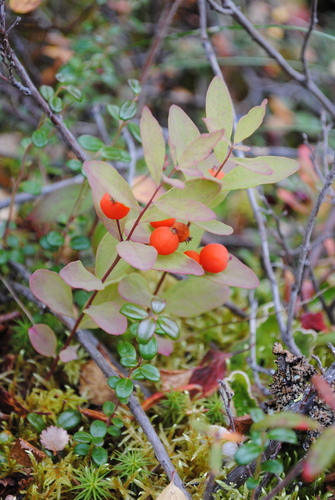
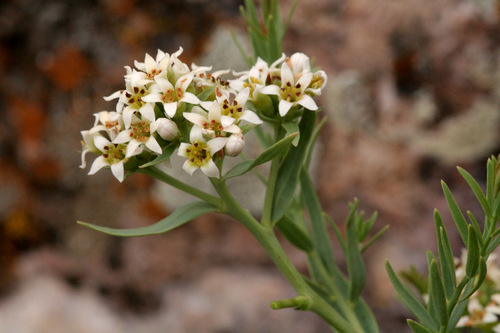
Comandra umbellata is a perennial herb that grows from rhizomes, reaching 8 to 34 centimetres tall, and most often occurs in drier or semi-sandy soils. Its leaves are alternately arranged, and grow up to 3.3 cm long. Flowers grow in flat or roundish clusters; they lack petals and instead have five greenish-white sepals. All flowers hold both male and female reproductive structures, and the species is pollinated by insects. The fruit produced is a drupe 4–6 mm thick. Three accepted subspecies of Comandra umbellata are recognized: Comandra umbellata subsp. californica, commonly called California bastard toadflax; Comandra umbellata subsp. pallida, called pale bastard toadflax or pine bastard toadflax; and Comandra umbellata subsp. umbellata. Comandra umbellata is hemiparasitic, not holoparasitic, because it produces some of its nutrients through photosynthesis. It has a wide host range, and is known to parasitize more than 200 different plant species. Confirmed hosts include plants from the genera Acer, Antennaria, Aster, Betula, Carex, Solidago, Fragaria, Populus, Quercus, Rosa, Rubus, Vaccinium, as well as some grasses. In Europe, the common English name bastard toadflax refers to plants in the genus Thesium, not this species. The Navajo people made a decoction of this plant's parts for narcotic and other medicinal uses. During periods of food shortage, Native Americans ate the berries of this plant as a food source. While the berries are small, they have a sweet taste. If this plant grows in soil with high selenium content, its fruit may contain toxic levels of selenium.