About Colus pusillus (Berk.) Reichert
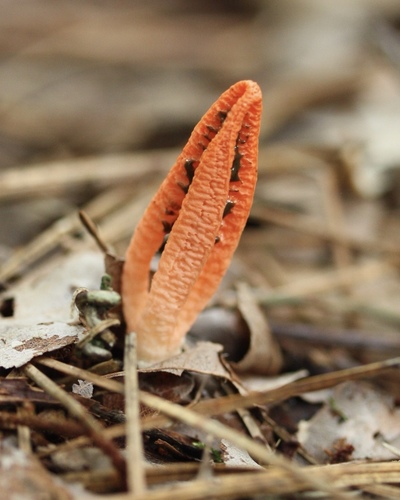
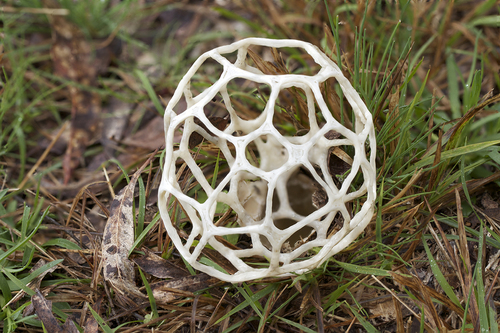
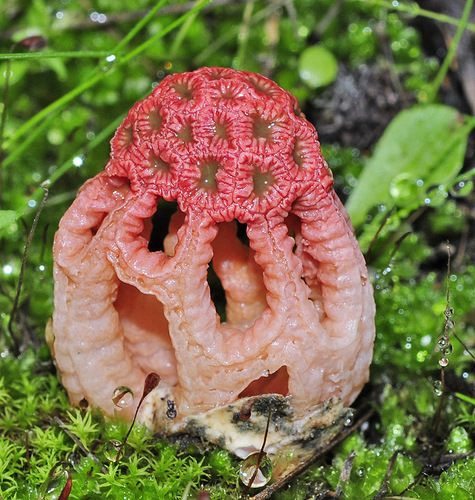
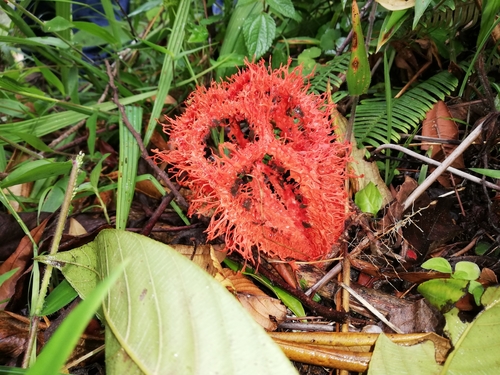
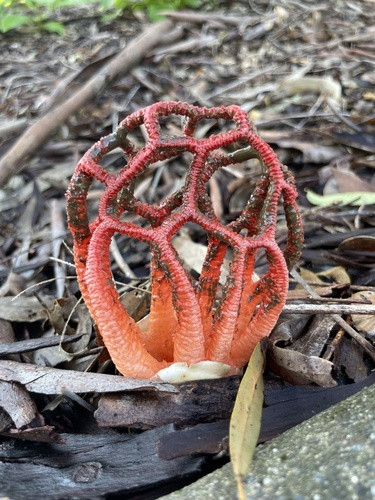
Colus pusillus is a species of fungus in the family Phallaceae, found in Australia. It is sometimes called the craypot stinkhorn or basket stinkhorn, named for the unique appearance of its fruiting bodies. These fruiting bodies are made up of vivid red, wrinkled arms that branch and connect to form a cage-like structure, similar to that of the related species Clathrus ruber.
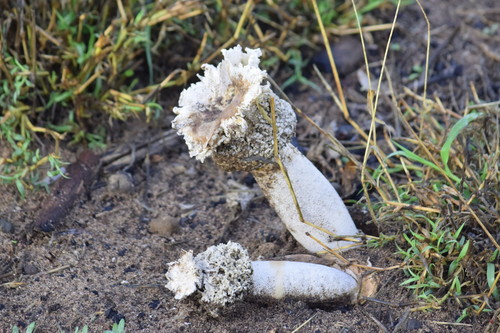
This fungus is saprobic, and as a result, it often grows on garden mulch. Like all stinkhorns, the fruit body of C. pusillus starts as an egg-like structure. The eggs of C. pusillus are usually off-white, with a red or purple tinge and a faint latticed pattern on the surface. They are anchored to their growing substrate by one or more root-like rhizomorphs, which are thickened strands of mycelium.
The membrane of the "egg" soon ruptures, releasing the rapidly expanding mature receptacle, which can reach a height of around 15 centimeters. The interior of the cage is covered in unevenly distributed glebal slime that holds the fungus's spores. This slime is olive-green in color and has a foul odor, which attracts insects that carry the fungus's spores to new suitable locations.