About Columbina talpacoti (Temminck, 1810)
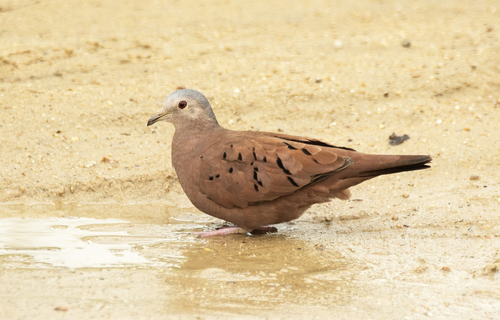
This species, Columbina talpacoti, measures 12–18 cm (4.7–7.1 in) in length and weighs approximately 35–56 g (1.2–2.0 oz). Adult males have reddish-brown feathers as the dominant body color, which contrasts with their bluish-gray heads. Females are entirely brown. Both sexes have a series of black spots on their wing feathers. Hatchings already show faint traces of the adult plumage typical of their sex. Four subspecies of Columbina talpacoti are recognized. Only one of these subspecies occurs in Brazil: C. t. talpacoti, first described by Temminck in 1810. The other three subspecies have distinct ranges. Columbina talpacoti caucae, described by Chapman in 1915, occurs in the Colca River valley in western Colombia. Columbina talpacoti eluta, described by Bangs in 1901, occurs along the Pacific coast of Mexico, from northern Sinaloa state to southern Chiapas state. Columbina talpacoti rufipennis, described by Bonaparte in 1855, ranges through central and eastern Mexico, Central America, extending to Colombia and northern Venezuela. This range includes Margarita Island, Trinidad, and Tobago. C. t. talpacoti (Temminck, 1810) is found in eastern Ecuador, eastern and northern Peru, eastern Guyana, Bolivia, Paraguay, Uruguay, northern Argentina, and Brazil. It also occurs occasionally as a visitor in central Chile and Chile’s Lakes region. The species adapts well to human-created artificial environments, and lives in open areas. Deforestation has facilitated its range expansion, particularly into areas cleared for pasture or grain farming. It has become established in large cities in southeastern and midwestern Brazil. Individuals are very aggressive toward one another; while they can form groups, they compete for food and defend territories by striking opponents forcefully with one of their wings. Males are more belligerent than females. During disputes or when sunbathing, these doves lie on their side on the ground with a wing stretched upward, displaying the large area of black feathers under the wing. Bird watchers in south-central United States have observed that this species is being replaced by another pigeon species, Zenaida auriculata, commonly called the eared dove, also known as dove-of-band or amargosinha. Zenaida auriculata has been increasingly successful at colonizing urban environments, and appears to compete with Columbina talpacoti. Columbina talpacoti is already less common than the flock pigeon in most cities in the interior of São Paulo. Despite this competition, this friendly, even naive species is still far from disappearing from residential backyards, city squares, and urban gardens, even those in large built-up areas.