About Columbina passerina (Linnaeus, 1758)
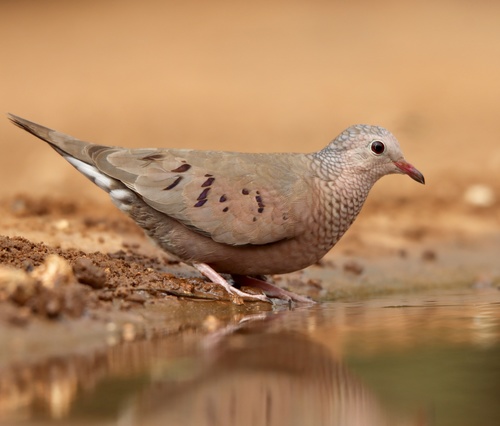
The common ground dove, with the scientific name Columbina passerina (Linnaeus, 1758), is the smallest dove species in North America, and one of the smallest by mass in the world. Adults of this species measure 15–18 cm (5.9–7.1 in) in length, have a total wingspan of 27 cm (11 in), and weigh between 26–40 g (0.92–1.41 oz). The common ground dove has a yellow beak with a black tip, and the feathers surrounding its beak are pink. Feathers on the head and upper breast have a distinct scale-like appearance. Its tail feathers are very short and match the brown colour of the bird's back. Its coverts and wing feathers are also brown, but these feathers have black spotting. The species has chestnut-coloured primaries and wing borders, which are only visible when the bird is in flight. There is sexual dimorphism in this species' plumage: males have slate-gray feathers on the top of the head and pink-gray colouration on the belly, while females are grayer overall than males and have more evenly distributed colour across their bodies. The call of the common ground dove consists of soft whoops that increase in pitch. Calls are typically repeated and quite distinct; a link to a website featuring the species' call can be found in the external links. The common ground dove is distributed across the southern tip of the United States, most of Mexico, parts of Central America, the Caribbean islands, and northwestern South America. This species does not migrate, and remains a year-round resident in all areas it inhabits. It lives in open areas with trees and bushes, and can also be found in forests that contain sandy areas, farmlands, savannahs, and areas near human infrastructure. While common ground doves generally hold defined territories, they are rarely aggressive toward intruders.