About Columbina minuta (Linnaeus, 1766)
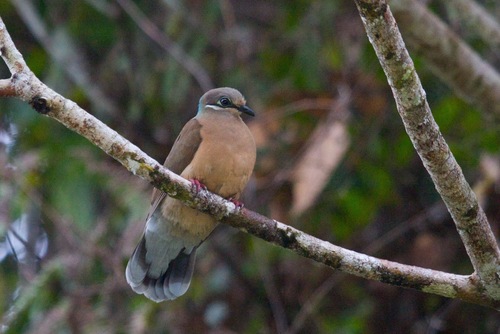
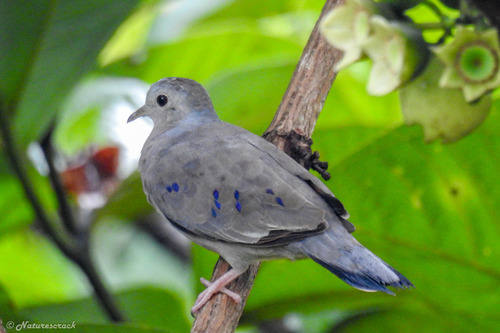
Plain-breasted ground dove, scientifically named Columbina minuta (Linnaeus, 1766), has a total length of approximately 14.5–16 cm (5.5–6.5 in) and a weight of 24–42 g (0.85–1.48 oz). On average, this species is slightly smaller than the common ground dove. It may be the smallest columbid species by body mass, though the more heavily built, almost tailless dwarf fruit dove of Southeast Asia is typically shorter in overall length. This dove has dark grey to brown plumage, with somewhat paler wings marked by dark violet spots; its underwings are mostly rufous. It has a grey bill, pink legs, and reddish eyes, with subtle physical differences between males and females. This species can be confused with Columbina talpacoti (ruddy ground dove) and C. passerina (common ground dove). The ruddy ground dove tends to be duller with less red tint, while the common ground dove has a speckled head and neck. This is a widespread non-migratory species with a discontinuous range covering 18,800,000 square kilometres (7,300,000 sq mi). It occurs in northeastern Argentina, Belize, Bolivia, Brazil, Colombia, Costa Rica, Ecuador, El Salvador, French Guiana, Guatemala, Guyana, Honduras, Mexico, Nicaragua, Panama, Paraguay, Peru, Suriname, Trinidad and Tobago, and Venezuela. It prefers arid climates, and its natural habitats include dry savanna, subtropical or tropical dry shrubland, subtropical or tropical high-altitude shrubland, subtropical or tropical seasonally wet or flooded lowland grassland, and heavily degraded former forest. It is most common in lowlands, but also occurs in foothills, and uncommonly reaches up to 2,100 metres (6,900 ft) above sea level. The plain-breasted ground dove is diurnal, with activity peaking in mid-morning and afternoon. It forages for grain and fruits in open areas such as grasslands. It processes food in its gizzard with the help of stones. Like other columbids, this species drinks via suction, which is not typical for most birds — most birds collect water in their oral cavity then raise their heads to drink using gravity. C. minuta is monogamous, and individuals guard their nesting sites. Its average generation length is around 2.6 years. Males perform courtship displays by tilting their head while calling with an inflated crop, which visibly expands their neck and chest. This species nests on the ground, though it may also nest in trees; tree nests are smaller than ground nests. Its eggs are white, measure around 21.5 mm long by 16.3 mm wide, and are laid in clutches of one to two eggs. Both parents take turns caring for eggs and young: the male cares during the day, and the female cares at night. Young are fed crop milk for the first few days after hatching, and continue to be fed by their parents for some time after fledging.