About Columba trocaz Heineken, 1829
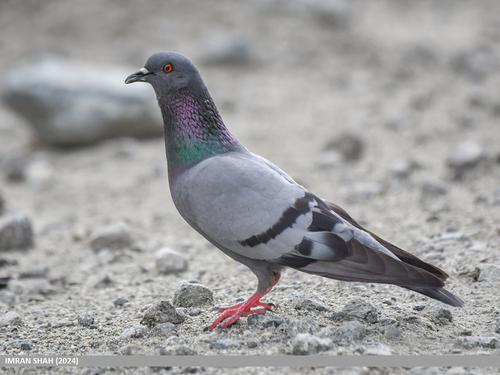
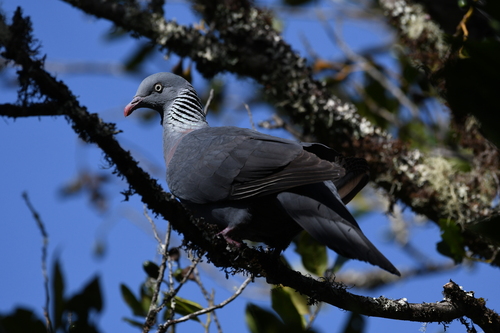
The trocaz pigeon, scientific name Columba trocaz Heineken, 1829, is a relatively plain dark grey bird. It measures 40–45 cm (15.7–17.7 in) in length, with a wingspan of 68–74 cm (26.8–29.1 in). Its upper back has a violet sheen, which shifts to green on the back of its neck, and the sides of its neck are patterned with silver-white. Its tail is blackish with a wide pale grey band, and its flight feathers are mostly black. It has a pinkish upper breast, yellow eyes, a bill with a yellow tip and reddish-purple base, and red legs. Male and female trocaz pigeons look very similar. Juveniles have generally browner plumage, and their silvery neck patch is either not developed or only poorly developed. When their wings are closed, pale buff feather edges give the wings a scaly appearance. The call of the trocaz pigeon is weaker and deeper than that of the common wood pigeon; it typically has six syllables, with the middle pair of notes extended and stressed, sounding like uh-uh hrooh-hrooh ho-ho. In flight, it looks heavy with a large tail, but its flight is rapid and direct. The common wood pigeon once had a poorly defined Madeiran subspecies, Columba palumbus maderensis. This subspecies was paler than the trocaz pigeon, had white wing patches and more extensive green iridescence on the nape, but it went extinct before 1924. Bolle's pigeon is more similar in appearance to the trocaz pigeon, but it lacks the trocaz pigeon's whitish neck patch and has a more extensively pink breast. However, Bolle's pigeon is endemic to the Canary Islands, so there is no overlap in their ranges. The only other pigeon species currently found on Madeira is the feral pigeon; feral pigeons are slimmer, have more pointed wings and a much smaller tail, often have dark wing markings, and have lighter flight. The trocaz pigeon is endemic to the mountainous subtropical Atlantic main island of Madeira, though it formerly bred on nearby Porto Santo Island. It is found mostly on the northern slopes of Madeira's mountains, with smaller populations in the south where suitable patches of laurel forest still remain. Its natural habitat is tall laurisilva forest or dense tree heaths that are covered by cloud for much of the year. These forests are mainly composed of laurel, Ocotea foetens, Madeira mahogany, Canary laurel, faya, lily-of-the-valley-tree and Picconia excelsa. The trocaz pigeon prefers primary forests, but it uses secondary growth for feeding, and also visits agricultural land, especially when fruit is scarce. Most trocaz pigeons live below 1,000 m (3,300 ft), and their preferred habitat is steep ravine-indented slopes along artificial watercourses, with occasional large dead laurel trees and abundant tree heath. This species moves very frequently between different areas at different times of year.