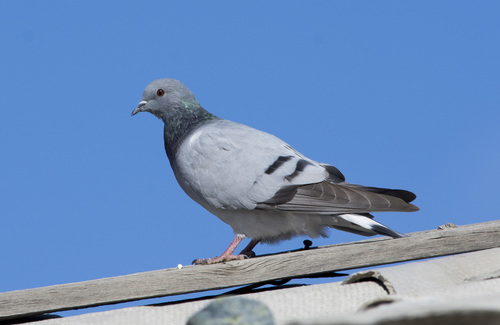
About Columba rupestris Pallas, 1811
The hill pigeon (Columba rupestris Pallas, 1811) is a stout-bodied pigeon similar in size and general appearance to the rock dove (Columba livia). It is mainly distinguished from the rock dove by its tail pattern: a broad white band running across its otherwise black tail. Other differences from the rock dove include a paler mantle and upper wings, plus a distinct white patch on the back. In flight, its tail pattern resembles that of the snow pigeon (Columba leuconota), but it does not have the strong contrast between the head and neck that marks the snow pigeon. This species is distributed across China, Pakistan, India, Nepal, Kazakhstan, North Korea, South Korea, Mongolia, Russia, Tajikistan, Afghanistan, and Turkmenistan. In Pakistan, its range is relatively limited to the far northern inner valleys of the Karakoram, Hindu Kush, and Pamirs. It occurs in northern Chitral (particularly the western part bordering Afghanistan’s Nuristan), further east in the Yasin and Hunza valleys of Gilgit, and in the Karakoram ranges of Baltistan. In this region, it lives at roughly 2000 m in winter, moving up to 5500 m during summer. Although its overall population is decreasing, the rate of decline is not a cause for concern. The species is widely distributed and abundant, so it is classified as Least Concern on the IUCN Red List. Hill pigeons frequent open rugged terrain at elevations between 1,500 and 6,100 m above sea level. They are closely related to rock doves, and are more commonly found at higher altitudes than rock doves. This is a gregarious species year-round, feeding in flocks on terraced cultivated fields. It often mixes with flocks of rock doves. It is very tame, and is frequently found near human settlements, camps, and pilgrimage routes. In Tajikistan, nesting can start as early as February, while young from later broods may fledge as late as September in northeastern Tibet. Male hill pigeons have a bowing display identical to that of the rock dove, and their overall courtship behavior matches that of the rock dove. They nest in dense colonies on cliffs, gorges, and rocky outcrops. In Tibet, nests are often placed in both occupied and unoccupied houses, or in wall holes. A nest is a simple platform made of twigs or plant stems, and most clutches contain two eggs. The species can raise two broods in a single year. Its feeding habits are similar to rock doves: it is primarily granivorous, and supplements its grain-based diet with green shoots and leaves, and occasionally small mollusks such as snails. On occasion, it feeds opportunistically on leftover human food, partially digested material from kiang dung, and even undigested food taken from the stomachs of kiang carcasses opened by other predators.