About Columba palumbus Linnaeus, 1758
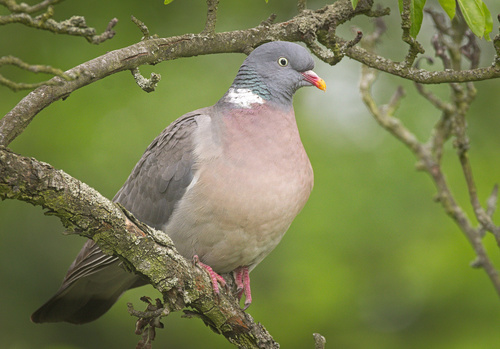
The common wood pigeon, Columba palumbus Linnaeus, 1758, is one of three Western European Columba pigeon species, along with stock dove and rock dove. While these three species look similar at first glance, each has clear distinctive characteristics. The common wood pigeon can be identified immediately by its larger size: 38–44.5 cm (15–17+1⁄2 in) long, weighing 300–615 g (10+5⁄8–21+3⁄4 oz), with white markings on its neck and wings. Its body is otherwise mostly grey, with a pinkish breast. Its wingspan ranges from 68 to 80 cm (27 to 31 in), the wing chord measures 24 to 25.4 cm (9+1⁄2 to 10 in), the tail measures 13.8 to 15 cm (5+1⁄2 to 6 in), the bill measures 1.9 to 2.2 cm (3⁄4 to 7⁄8 in), and the tarsus measures 2.5 to 2.8 cm (1 to 1+1⁄8 in). Adult common wood pigeons have a set of green and white neck patches, plus a pink patch on the chest. Their eye colour is pale yellow, which differs from the orange-red eyes of rock doves and the dark grey-brown to black eyes of stock doves. Juveniles do not have the white neck patches on either side of the neck. When juveniles are around six months old (approximately three months after leaving the nest), small white patches develop on each side of the neck. These patches gradually grow in size until they are fully formed when the bird reaches 6–8 months of age. Juveniles also have a greyer bill and an overall lighter grey plumage than adult birds. In colder northern and eastern Europe and western Asia, the common wood pigeon is a migratory species. In southern and western Europe, it is a widely distributed, often abundant resident bird. In Great Britain, common wood pigeons are commonly seen in parks and gardens, and they are increasingly found in towns and cities. In May 2019, a single common wood pigeon was sighted in La Romaine, Quebec, Canada. This is the only confirmed record of the species in the Americas.