About Columba oenas Linnaeus, 1758
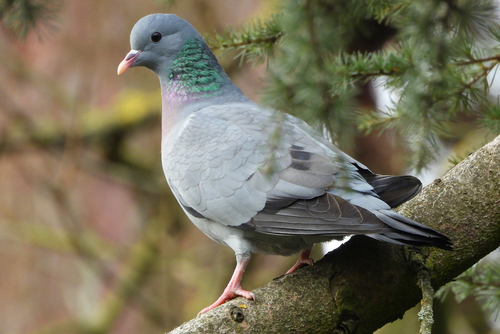
The stock dove, scientifically named Columba oenas Linnaeus, 1758, is a member of the genus Columba in the pigeon family. Members of the pigeon family are typically pale grey or brown, sometimes with white markings on the head or neck, and usually have iridescent green or purple patches on the neck and breast. Neck feathers may be stiffened and aligned to form grooves, though this feature is less obvious in the stock dove. The stock dove measures 28–34 cm (11–13 in) in length, with a wingspan of 60–66 cm (24–26 in). Males weigh 303–365 g, while females weigh 286–290 g. Its plumage is a blue-toned grey, with two short dark grey to blackish wingbars on the tertials and greater coverts, and a broad dark grey bar at the tip of the tail. The breast has a light pinkish-purple tint, and the sides of the neck hold an iridescent patch that shifts between green and purple depending on the angle of incoming light. The eyes are dark, and the bill is pink with a yellow tip. Males and females have identical plumage, though males are slightly larger. Juveniles are similar in appearance but lack the iridescent neck patch. In flight, the grey wings have a dark trailing edge, and the underwing is also dark grey — this differs from the white underwing of the rock dove. The stock dove’s short, deep, grunting Ooo-uu-ooh call is quite distinct from the modulated cooing of the common wood pigeon. The three western European Columba pigeon species each have unique distinguishing features. The common wood pigeon is easily identified by its large size, pale yellow eyes, and white markings on the neck (in adults) and wings. The rock dove and stock dove are more similar in size and plumage, but wild rock doves have brighter eyes, a white rump, and two distinct full dark bars on the wings, while the stock dove has a grey rump and incomplete wing bars. The stock dove is both sociable and gregarious, and often associates with wood pigeons, and occasionally with rock doves. The stock dove is common in its ideal habitat, but never reaches the same population abundance as the common wood pigeon. It typically forms flocks ranging from a few individuals to a few tens, very rarely numbering in the hundreds, unlike wood pigeons which often form flocks of thousands. It is a migratory species across part of its European and western Asiatic range. The stock dove has seen a sharp 57% population decline in France since 1976. While the species is not considered threatened across Europe, it is classified in Schedule 2 of the Birds Directive and Annex III of the Berne Convention. Around 100,000 to 200,000 individuals winter in France, and over half of the entire European stock dove population is located in the UK. The stock dove usually nests in holes in old trees. Before widespread deforestation, it was the most common pigeon species, nesting primarily in oak or pine forests. Because it relies on tree cavities for nesting, it was historically only found in old forests. It is scarcer in plantations, which do not provide many suitable nesting holes. Additionally, the stock dove is double-brooded, meaning it requires two separate cavities for its two broods. It has also been observed nesting in rabbit burrows, ruins, old poplar hedges, cracks in crags or cliff faces, in ivy, and in the thick growth around the trunks of lime trees. It will also use man-made nest boxes. The nesting cavity is typically about 75 centimetres deep, with an entrance large enough to fit a fist through. Although stock doves seldom use nesting material, the young leave the nesting cavity with very oily plumage. Stock doves prefer to nest close together, and outside of the breeding season, they may also roost in cavities. Like most doves and pigeons, they lay two eggs per clutch, though nests holding up to six eggs have been recorded; these are believed to result from dump-nesting by other females. The stock dove generally inhabits open wooded areas, and does not prefer densely wooded regions despite nesting in trees. It is also common on coasts, where cliffs provide suitable nesting sites. Its flight is quick and regular, with occasional sharp wing flicks that are characteristic of pigeons. It perches well. During its nuptial display, the male walks along a horizontal branch with a swollen neck, lowered wings, and a fanned tail. During the circling spring courtship flight, its wings crack sharply like a whip. Its diet consists mainly of plant material. It favours young shoots and seedlings, but will also eat grain, insects, and snails. In some areas, its diet is made up mainly of acorns and pine seeds. Its varied diet also includes berries such as bay and hawthorn, figs, cereal grains, beans, peas, and small invertebrates that it obtains while foraging on the ground. During their autumn migration in October, stock doves stop at sites with abundant acorns, and supplement their diet with shoots and leaves.