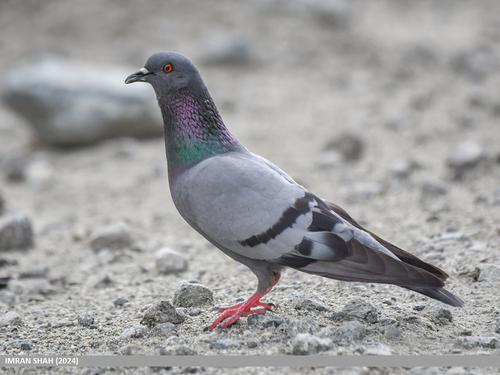
About Columba livia J.F.Gmelin, 1789
Thousands of years of domestication have greatly changed the rock dove (Columba livia) across many regions. Domestic and feral pigeons, which were developed through selective breeding rather than originating naturally, show much greater plumage variation than natural wild rock doves. Wild-type pure rock doves are endangered across many areas; the nominate subspecies C. l. livia survives most prominently in the far north and west of Scotland, and most abundantly in the Outer Hebrides. Adult nominate subspecies rock doves measure 30 to 35 cm (12 to 14 in) in length, with a wingspan of 62 to 68 cm (24 to 27 in). Wild and feral rock doves weigh between 238–380 g (8.4–13.4 oz); overfed domestic and semi-domestic individuals can weigh more than this normal range. Standard body measurements are: wing chord typically around 22.3 cm (8.8 in), tail 9.5 to 11 cm (3.7 to 4.3 in), bill around 1.8 cm (0.71 in), and tarsus 2.6 to 3.5 cm (1.0 to 1.4 in). This species has dark bluish-grey feathers on its head, neck, and chest, with glossy greenish to reddish-purple iridescence along its neck feathers. The pure wild rock dove’s most reliable identifying feature is its white lower back, and two distinct black bars on its pale grey wings are also characteristic. The tail has a black band at its tip, and the outer edge of each tail feather is edged with white. The iris is red-brown. The eyelids are grey, with a very narrow bluish-grey to grey-white eye ring, which is wider in domesticated and feral birds. The bill is grey-black with a small off-white cere; domesticated and feral birds have a much larger cere. The feet are red to pink. Adult females are nearly identical in outward appearance to males, but their neck iridescence is less intense and limited to the rear and sides, and iridescence on the breast is often very faint. Young females have very little iridescent sheen and are duller overall. When circling overhead, the bird’s white underwings become easily visible. In flight, behaviour, and voice, which produces a dovecot coo rather than the wood pigeon’s typical call, it is a typical Columba pigeon. Although it is a strong flier, it also glides often, holding its wings in a very distinct V shape during glides. Most subspecies are similar to the nominate subspecies, but can be told apart: Nominate C. l. livia has mid-grey mantle plumage and a relatively short tail. C. l. gymnocycla is smaller and much darker than the nominate; its head, rump, and underparts are almost blackish, it has a white back, and its nape iridescence extends onto the head. C. l. targia is slightly smaller than the nominate with similar plumage, but its back is the same colour as the mantle, rather than white. C. l. schimperi closely resembles C. l. targia, but has a noticeably paler mantle. C. l. dakhlae is smaller and much paler than the nominate. C. l. palaestinae is slightly larger than C. l. schimperi and has darker plumage. C. l. gaddi is larger and paler than C. l. palaestinae, and it intergrades with this subspecies in the west. C. l. neglecta is similar in size to the nominate but darker, with stronger and more extensive iridescent sheen on the neck; it intergrades with C. l. gaddi in the south. C. l. intermedia is similar to C. l. neglecta but darker, with a less contrasting back. There have been many detailed skeletal descriptions of the rock dove, including descriptions of associated muscles of the eye, jaw, neck, and throat. The rostrum, eye socket, and braincase make up most of the skull. The quadrate bone is relatively small and mobile, and connects the rest of the cranium to the lower jaw. The lower jaw has an angled shape when viewed from the side, because the long axis of the front half of the lower jaw sits at a 30° angle to the back half. Below the skull, the hyoid skeleton includes three mid-line structures and a pair of elongated structures that extend from between the junction of the back two mid-line structures. The anterior unpaired structure, the paraglossum or entoglossum, is shaped like an arrowhead. Pigeon feathers contain two types of melanin pigment: eumelanin and pheomelanin. One study measured the concentration, distribution, and proportions of these two melanins in feathers of wild rock doves and domestic pigeons of different colour types with known genetic backgrounds. It found that gene mutations altering pigment distribution, total amount, and proportions explain the greater colour variation seen in domesticated birds compared to their wild relatives. Eumelanin generally produces grey or black colouration, while pheomelanin produces reddish-brown colouration. Other shades of brown can be created through different combinations and concentrations of the two pigments. Darker birds may be better able to store trace metals in their feathers due to their higher melanin concentrations, which may help reduce the negative effects of these metals, which typically occur at higher concentrations in urban areas. The natural distribution of the rock dove is a limited resident range covering western and southern Europe, North Africa, and extending into South Asia. The species was introduced to most of the rest of the world on European ships starting from 1603. When feral populations are included, the species has an extremely large range, with an estimated global extent of occurrence of 10,000,000 km2 (3,900,000 sq mi). It has a large global population, including an estimated 17 to 28 million individuals in Europe. Fossil evidence indicates the rock dove originated in southern Asia, and skeletal remains found in Israel confirm the species existed there at least 300,000 years ago. However, due to its very long history of association with humans, it is impossible to determine the species’ exact original native range. Wild rock doves live on rock formations and cliff faces, nesting in crevices. Wild nesting sites include caves, canyons, and sea cliffs. They can even live in the Sahara as long as an area has rocks, water, and some plant material. They prefer to avoid dense vegetation. Pigeons are often found in pairs during the breeding season, but are generally gregarious, living in flocks of 50 to 500 birds depending on food availability. As prey animals, they must stay alert; when disturbed, a flock member will take off with a loud clapping sound that signals other pigeons to fly away. The noise of take-off gets louder the faster the pigeon beats its wings, so it communicates how large the perceived threat is to other flock members. Non-vocal sounds include a loud flapping noise at take-off, foot stamping, hisses, and beak snapping. Wings may also be clapped during flight, usually during display fights or after copulation. Juveniles especially snap their bills, usually in response to nest invasion. Foot stamping appears to be deliberate, though its purpose is not yet clear. Rock doves always start foot stamping with a specific foot, which means they have “footedness”, similar to human handedness. This species can breed at any time of year because it can produce crop milk, but breeding peaks in spring and summer, when food supplies are abundant enough to support embryonic egg development. Females can lay eggs up to six times per year. Nests are built on coastal and mountain cliff ledges and in caves. Courtship displays of feral pigeons are often seen in urban parks at any time of year, and wild populations are presumed to have similar displays. Perched males inflate their crops and puff out the feathers on their neck to appear larger, to impress or attract females. He approaches the female walking quickly while making repeated soft calls, often bowing and turning as he gets closer. Initially, the female almost always walks or flies a short distance away, and the male follows her until she stops. At this point he continues bowing, and very often does full or half pirouettes in front of the female. The male then feeds the female by regurgitating food, the same way they feed young. Next the male mounts the female, leaning backwards to allow cloacal contact. Mating is very brief, and the male flaps his wings to stay balanced on top of the female. Rock doves are generally monogamous, and each brood produces two squabs (young). Both parents care for the young for a period after hatching. Current evidence shows that wild, domestic, and feral pigeons usually mate for life, though long-term pair bonds are not unbreakable. They are socially monogamous, but extra-pair matings do happen, most often initiated by males. The nest is a flimsy platform made of straw and sticks, built on a ledge under cover. The female lays two white eggs. Incubation is shared by both parents, and lasts 17 to 19 days. Newly hatched squabs have pale yellow down and a flesh-coloured bill with a dark band. For the first few days, the chicks are cared for and fed exclusively via regurgitated crop milk (also called pigeon milk). Both parents produce crop milk in their crop, as do all species of pigeons and doves. Pigeons are altricial, and their fledging period is around 30 days. A rock dove’s lifespan ranges from 3–5 years in the wild to 15 years in captivity, though longer-lived individuals have been recorded. The main causes of death in wild rock doves are predation and persecution by humans.