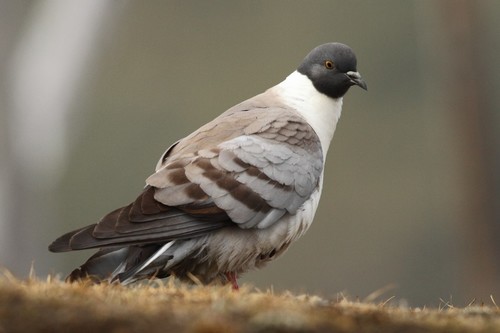
About Columba leuconota Vigors, 1831
Snow pigeons (Columba leuconota Vigors, 1831) have a blackish head that contrasts with a white neck collar and white underparts that fade to ashy grey on the abdomen. Their backs are brownish-grey, with a white patch on the lower back. Their wings are pale grey and marked with three brown bands. Their black tails have a distinct white band across the middle; this band narrows and curves forward to reach the tip of the outermost tail feathers. Juvenile snow pigeons have narrow, pale buff margins along the feathers of their upper parts and wings. The white coloration of their underparts is stained and dulled with buff. This species is a resident bird that lives in rocky hills across Afghanistan, Bhutan, China, India, Kazakhstan, Myanmar, Nepal, Pakistan, Tajikistan, and Turkmenistan. It is a common species with an extremely large range, and its population is believed to be stable. For these reasons, the International Union for Conservation of Nature has assessed its conservation status as Least Concern. Snow pigeons most often occur on rocky hillsides and in isolated valleys, and can be seen up to the snow line. They regularly feed in open fields during the day, but roost on cliffs. They are typically shy and wary of other beings. In winter, groups of 150 or more individuals can gather, often mixing with flocks of hill pigeons, and sometimes also with rock doves in certain regions. In summer, snow pigeons descend to lower elevations, and are found either in pairs or small flocks. They breed in colonies. Their nests are built in crevices or caves on cliff faces, or on rocky ledges. Nests are untidy interwoven structures constructed from sticks, grass, straw, feathers, and other similar materials. Nests are generally reused each year, with only minor repairs needed when reused. Clutches usually contain two eggs. Snow pigeons feed on berries, grain, buds, bulbs, seeds, and shoots.