About Columba leucomela Temminck, 1821
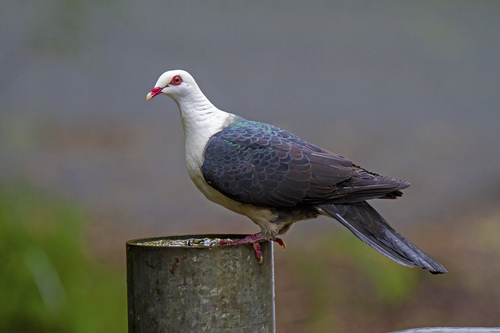
This species is the white-headed pigeon, scientifically named Columba leucomela Temminck, 1821. It gets its common name from the distinctive white coloration of its head, neck, breast, and belly. Males have slate grey wings and tail, grey black upperparts with green or purple iridescence. Their bill ranges from pink to dark red with a yellow or white tip, and their legs and feet are pink to red. Females are similar in appearance to males, but their white coloration is less brilliant and more muddied. Juveniles resemble females, but have a greyer head and darker grey underparts. Their feet, legs, and bills are also greyer, though the bill still has a white tip. Adult white-headed pigeons measure 38–42 cm (15–17 in) from beak to tail, and weigh around 420 g (15 oz). They have red eye rings and legs, and pale orange or yellow eyes. Their call is loud and gruff, sounding like "WHOO!" followed by a gruff inhalation "uk", and this sequence is repeated three times. Sometimes the call is a low "oom". White-headed pigeons live along Australia's east coast, ranging from Cooktown, Queensland to southern New South Wales, and increasing numbers are now found in eastern Victoria. They are most commonly found in tropical regions, subtropical rainforest, scrub, watercourses, and street trees. Since the colonisation of Australia, their overall numbers have decreased, but the species has thrived feeding on the introduced Camphor laurel (Cinnamomum camphora). The white-headed pigeon builds a scanty nest from twigs, usually placed high in a tree canopy up to 18 metres above ground. It typically lays a single cream-white egg. Breeding occurs mostly from October to December. These pigeons are most often found alone, in pairs, or in small flocks. They are very quiet and elusive, and their flight is swift and direct.