About Columba junoniae Hartert, 1916
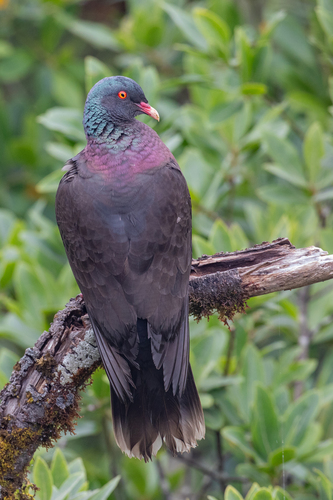
Columba junoniae, commonly known as the laurel pigeon or white-tailed laurel pigeon, is a 40 cm bird with dark brown and grey plumage, and it resembles a very dark wood pigeon. Its underparts are reddish, its tail is pale grey with a broad, whitish terminal band. The rear crown and hindneck have extensive green gloss that becomes pink on the upper mantle. The bill is pink with a white tip, and the eye is orange in colour. It can be distinguished from the similar Canarian Bolle's pigeon (Columba bollii, also called dark-tailed laurel pigeon), which has a pale grey subterminal band and a blackish terminal band on its tail. This is a rare resident breeder that lives in mountain laurisilva and Canary pine forests. The laurel pigeon builds a stick nest in a tree and lays one white egg per clutch. Its flight is quick, with regular wing beats; an occasional sharp wing flick is characteristic of pigeons generally, and the species often takes off with a loud clattering. Its call is a hoarse, hiccuped cooing. The laurel pigeon is endemic to the mountainous subtropical Atlantic west Canary islands, where it occurs on La Palma, La Gomera, Tenerife and El Hierro. In the 1980s, its total population was estimated at 1,200–1,480 individuals, but more recent surveys show it is more numerous and more widely distributed than previously thought. The largest subpopulation is found on La Palma, across much of the northern half of the island. The species is common on La Gomera, where it is found primarily in the north, and also occurs patchily on the northern slopes of Tenerife. It has recently been recorded on El Hierro, but breeding there has not yet been confirmed, and the species was recently suspected to be declining on Tenerife. It occurs mainly on the northern mountain slopes, with smaller numbers found in the south where suitable patches of laurel forest remain. Bones similar to laurel pigeon bones have been found on neighbouring Gran Canaria, but it is unclear whether these remains belong to the white-tailed laurel pigeon or to Bolle's pigeon. A programme to (re)introduce the white-tailed laurel pigeon to Gran Canaria commenced in 2012. The species' natural habitat is tall laurisilva forest or dense tree heaths that are cloud-covered for much of the year. These forests consist mainly of Azores laurel, Oreodaphne foetens, til, Madeira mahogany, Canary laurel, faya, lily of the valley tree and picconia. The species is found mostly below 1000 m (3300 ft), and its prime habitat is steep ravine-indented slopes along artificial watercourses, with occasional large dead laurel trees and extensive tree heath. It is highly mobile between different areas at different times of year. It was very abundant when the Canary Islands were first colonised by humans, but was extirpated from much of its range, largely due to deforestation for wood, agricultural land, and grazing land. Excluding livestock from native forest allows forest regeneration and creates more suitable habitat for the species. Some illegal hunting and poisoning continues because the pigeon can damage crops. The main limiting factor slowing the species' population growth is thought to be the removal of eggs and young by introduced black rats. It is currently classed as Near Threatened on the IUCN Red List, which is an improvement from its 1988 classification as Threatened. This species is protected under the European Union Birds Directive, and its laurel forest habitat is protected under the Habitats Directive. Ecologically, the laurel pigeon prefers areas with steep slopes, escarpments and gullies, and occurs in dry forest, laurel forest, Canary pine forest, and cultivated areas. Unlike the earlier description of nests built in trees, most nests are placed on the ground, in fissures, holes or small ledges, at the bases of trees, and under rocks or fallen tree trunks, located in steep, rocky, shady areas with abundant shrubby vegetation. The breeding season varies between islands, but spans from January to September, with a peak between April and June. Pigeons can breed starting in their first year, and nesting occurs throughout the year, though mainly from February to June. On Tenerife, breeding success appears to be low as a result of intense nest predation. Male courtship displays are similar to those of the common wood pigeon. In flight, the male climbs quickly, gives a loud wing-clap, then glides down with his wings and tail spread; this display may be repeated two or three times before the bird returns to a perch. On the ground, the male performs a bowing display with his neck inflated to show off its iridescent neck patches; he raises his tail, fans it, then closes it again, and the display is usually accompanied by calling. The nest is a typical flimsy pigeon structure made of twigs and grasses. When placed on the ground, it is usually positioned high on the floor of canyon walls with heavy vegetation, nestled among rock crevices in hill gullies. The usual clutch holds one smooth white egg. Nest predation is the leading cause of nesting failure for the two Canarian endemic pigeons (Bolle's laurel pigeon and the white-tailed laurel pigeon), accounting for 88% of failure, and it affects the white-tailed laurel pigeon more heavily. Predation rates are higher for ground nests than for tree nests, and lower in the February–March period than in June–July and September–October. Predator abundance follows this same seasonal pattern, while fruit availability decreases from the first to the third seasonal period. Automatic camera monitoring identified the introduced black rat (Rattus rattus) as the major nest predator for both species. This pattern of predation impacts the white-tailed laurel pigeon much more than Bolle's laurel pigeon, because the white-tailed laurel pigeon breeds on the ground mainly between April and July, while Bolle's laurel pigeon breeds in trees mainly between February and June. These findings indicate that black rats are the key factor behind the scarcity of the white-tailed laurel pigeon on Tenerife. The laurel pigeon is exclusively herbivorous. Nearly 60% of its diet is fruit, most of the rest is leaves, and only 1% is flowers. The fruits of til, Azores laurel and Persea indica, plus the fruits and leaves of small-leaved holly, are the most commonly consumed food items. Most seeds pass through the pigeon's digestive system intact, except for Azores laurel seeds, which are usually damaged. Fruit makes up the main diet component when it is readily available in autumn and winter. When fruits are scarce in spring and summer, the pigeon consumes more leaves. In one study, 27% of consumed leaves came from native trees (especially small-leaved holly), 61% from herbs and shrubs, and nearly 10% from introduced trees, mainly apples and peaches. The species feeds in agricultural areas, where cabbage is the most commonly taken crop plant. When the fruit crop of til and Azores laurel is poor, large numbers of pigeons leave the forest to feed on cabbage, flowering cherries and vine shoots. In some parts of the islands, food competition between the pigeon and rats can be significant.