About Columba janthina Temminck, 1830
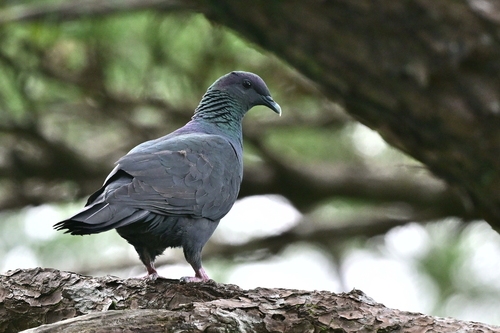
This species, the black wood pigeon (scientific name Columba janthina Temminck, 1830), is the largest pigeon in the East Asia region. It measures between 37 cm and 40 cm in length, and some individuals reach 43.5 cm. It has a small head, longish neck and long tail, with an overall very dark appearance. At least three subspecies of Columba janthina are recognized, differing slightly in plumage. Its entire body is covered in shiny soot-black feathers, with iridescent green or purple coloring on the crown, shoulders and sides of the neck; the crown and rump have bright metallic purple, while the back and chest carry a green-purple metallic sheen. Its irises are brown, adult legs and tarsi are red, and its bill is longish, narrow and dark. The beak is greenish blue with an ivory to pale yellow tip, and the fleshy cere covering the beak is small. This species has no sexual dimorphism, meaning males and females have similar appearances. Juveniles have generally paler plumage, lack or have only a poorly developed pale yellow neck patch, and have paler tarsi than adults. In flight, it looks similar to a crow, with large wings and a slightly fanned tail.
Black wood pigeons are resident on small islands in the East China Sea, primarily the Ryukyu Islands, Iwo Jima, and the Bonin Islands, and also occur along the southern coasts of Korea and Japan. Currently, it remains a resident species on 15 islands and islets, though it was historically more abundant and had a larger range. In South Korea, it occurs locally on small islands off the south coast, breeding on Ulleungdo Island, Jeju-do, and some offshore south coast areas. It has been recorded as a vagrant in eastern Russia, Shandong (mainland China), and Taiwan. In Japan, it is an uncommon local resident found on small islands off southern Honshu, Shikoku, and Kyushu, ranging south through the Nansei-Shoto (Ryukyu) Islands to the Yaeyama Islands, and through the Izu Islands to the Ogasawara and Iwo Islands; it is also distributed in the Honshu region. While still relatively common on the Izu Islands, its population there has declined since the 1950s. Its population on Okinawa declined during the 1980s due to forestry activities. The subspecies Columba janthina nitens, found only on the Ogasawara and Iwo Islands, is very rare.
The black wood pigeon is endemic to islands of the Sea of Japan, Yellow Sea, and East China Sea. It is primarily an isolated island wood pigeon, a robust and confident forest bird adapted to the habitat and vegetation of island laurel forest, sharing characteristics with other members of the genus Columba. Like some island races of the common wood pigeon and pigeon species from Macaronesian or Pacific islands, it has a low reproductive rate. It is considered omnivorous, though most of its diet is plant-based, with a strong preference for plants. It eats worms and small snails, but feeds mostly on plants: leaves, flowers, drupes, berries, fruit, acorns, pine nuts and other conifer seeds, and fruits from specific plant species including Ilex rotunda (Kurogane mochi), Ilex integra (mochi-no-ki), Camellia sasanqua (Sazanqua), Camellia japonica (Tsubaki), mulberry trees, ficus, Machilus thunbergii, and Nandina domestica. It feeds directly from trees, collecting seeds, buds and fruit, and prefers to forage in trees near ponds and rivers.
It is a resident breeder in laurisilva (laurel) forests. It builds a flimsy twig nest, which is placed in a tree cavity or among rocks, and lays one white egg per clutch, laying in September. It inhabits dense subtropical forests, and also occurs on beaches and islands within warm temperate evergreen broadleaf forests; it is heavily dependent on mature forests. It feeds on tree berries, and in turn disperses the seeds of these trees. It also eats leaves and flower buds, especially nitrogen-rich foliage during the breeding season. Its diet shifts seasonally with fruit availability; when fruit is scarce, leaves can make up the majority of its diet. Favorite foods include leaves from the genus Prunus, young shoots from Asteraceae, Caryophyllaceae, and cruciferous plants, and the rounded, fleshy leaves of ilex. This species plays an important ecological role, as it is the only bird capable of consuming the largest native fruits and drupes from some native tree species.
Black wood pigeon populations declined sharply after human colonization of its native archipelagos, and the species has disappeared entirely from some islands. The main cause of population decline is habitat loss from forest clearance, but hunting and nest predation by introduced species such as rats have also contributed to declines. Protection of laurel forests and a ban on hunting could allow its population to increase, though the species remains endangered. Black wood pigeons often use Camellia japonica for nesting and feeding, and also use Machilus thunbergii forests in Korea. For this reason, the distribution of Machilus thunbergii is closely linked to that of the black wood pigeon, and preservation of Machilus thunbergii is directly connected to the protection of this species. Between late July and late August, black wood pigeons feed on the fruits of silver magnolia growing in seaside silver magnolia habitats.