About Columba guinea Linnaeus, 1758
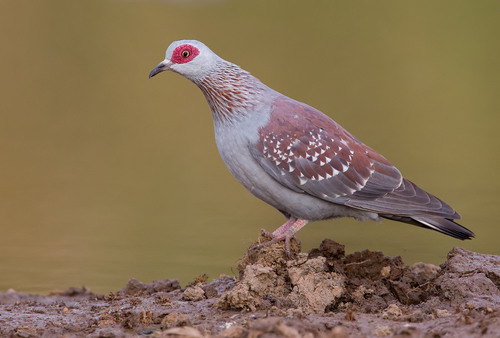
Columba guinea Linnaeus, 1758, commonly called the speckled pigeon, is a medium-sized pigeon that measures 32–35 cm in length, a size similar to the rock dove and stock dove. It has rufous coloration on its back and wings; its wings are heavily marked with small white speckles. The remaining portions of its upperparts and underparts are blue-grey. The head is grey, with bare red skin patches surrounding the eye. The neck is brownish with white streaks, and its legs are red. Adult males and females look similar to one another. Immature birds are browner than adults, and do not have the red bare skin patches around the eyes. The species' call is a loud doo-doo-doo. In terms of behaviour and ecology, the speckled pigeon is commonly found near human settlements and agricultural areas. Its diet consists mostly of plant matter, and it will gather in large flocks where grain or groundnuts are available. This species builds a large stick nest in sheltered locations on rocky outcrops; in urban areas, nests are often built on top of covered pergola pillars and on flat roofs under deep eaves. The female lays two white eggs per clutch. Its flight is quick, with regular wing beats and an occasional sharp flick of the wings, a flight pattern typical of most pigeon species.