About Columba elphinstonii (Sykes, 1832)
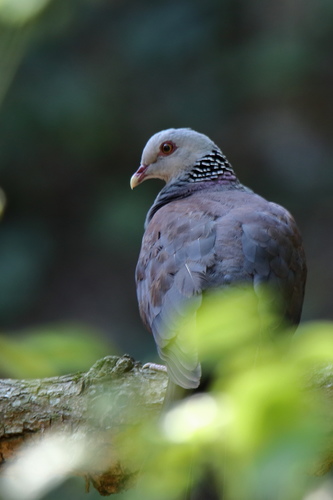
This species of pigeon, Columba elphinstonii, has an overall dark grey appearance. Its most distinctive feature is a black and white patterned patch on the back of the neck, formed by stiff feathers with white tips. The mantle is chestnut in colour. Males have a paler grey crown, while females have a darker grey crown paired with a pale throat. The species most easily confused with this pigeon is the mountain imperial pigeon, which can be distinguished by its paler underwing coverts. Columba elphinstonii has red feet and a red base to the bill. Evolutionarily, this species is closely related to the Ceylon woodpigeon Columba torringtoni and the ashy wood pigeon Columba pulchricollis. These three species form a clade that is basal within the Old World genus Columba. The species' binomial name commemorates Mountstuart Elphinstone, who lived from 1779 to 1859. This species is primarily distributed along the Western Ghats and in the Nilgiri Hills. While it mainly occurs in hilly areas, it can sometimes be found at lower elevations within the Western Ghats. A small number of relict populations remain in high elevation hills of the peninsula, including the Biligirirangan Hills and Nandi Hills near Bangalore. Nilgiri wood pigeons are most often encountered alone, in pairs, or in small groups. They feed almost entirely in trees, but will sometimes descend to the ground to forage for fallen fruits. Though fruit makes up most of their diet, they have also been recorded eating small snails and other invertebrates. Their breeding season runs from March to July. During this period, they build a flimsy platform nest from twigs, and lay a single white egg that is typically visible from beneath the nest. They feed on large fruits, and may play an important role in seed dispersal for many species of forest trees. They particularly favour fruits from the family Lauraceae. They gather most of their food by gleaning on the outer twigs of the middle and upper forest canopy. They have been recorded eating soil, which may provide them with mineral nutrients or aid digestion. They often move within forest areas based on the fruiting seasons of their preferred trees. Their call is a loud, langur-like low-frequency hooting: it starts with one "who", followed by a series of deep "who-who-who" notes.