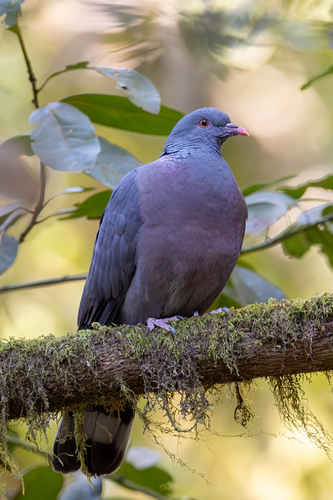
About Columba bollii Godman, 1872
Bolle's pigeon, scientifically named Columba bollii Godman, 1872, is a large pigeon larger than the common pigeon, with a total length between 36 cm and 40 cm. It is a large dark grey pigeon that resembles a very dark wood pigeon. It can be distinguished from the laurel pigeon, the other pigeon species endemic to the Canary Islands, by its dark grey rather than brown plumage, and dark bands on its grey tail. It is fundamentally a dark grey bird with a pinkish breast, and has no white markings; this lack of white markings alongside its darker plumage sets it apart from other related pigeon species. Its beak is red, with the most intense coloration at the tip. It has a relatively large, slate-grey head; males have bluish or greenish metallic coloration on the sides and back of the neck. Its eyes are rounded, ranging from yellow to orange with a black pupil, and are lightly framed by a thin, flesh-colored eye ring. The back, rump and wings are brownish grey; adult males have metallic blue shoulders. The primary and secondary flight feathers are blackish brown. The chest is dark blue-grey, and takes on a purple tint in males. The belly is a pale pastel grey. Females have less conspicuous coloration; they lack the highlights, reflections and metallic hues of males, and their overall coloration is more muted grey. In general summary, this species is mainly dark grey with blacker flight feathers, a paler grey tail with a dark terminal band, a gloss of green and pink on the hindneck, and a reddish tinge to the breast. It is only likely to be confused with the white-tailed laurel pigeon Columba junoniae or dark feral pigeons. Its call is a guttural, mournful cooing. Its flight is quick, powered by regular wing beats with an occasional sharp flick of the wings, which is characteristic of pigeons generally. It takes off with a loud clattering noise. When looking for this species, watch for birds flying low and fast over laurel forest. This is a resident breeding species found in the mountain laurisilva forest zone of the Canary Islands, Spain. It currently occurs on Tenerife (particularly at Anaga and Teno), La Palma (in a restricted area of the northeast), La Gomera (in Garajonay National Park, with some birds living outside the park), and El Hierro (where it occurs in Golfo and Sabinosa). It may have formerly occurred on Gran Canaria: bones similar to those of a laurel pigeon have been found there, and there is a possible sight record from the late 19th century. This species was common in the past, but disappeared from many areas due to the clearance of laurel forest across the islands. More recently, the rate of laurel forest clearance has slowed or stopped entirely. Population estimates for the species are 1,160–1,315 birds in 1980, 6,000 individuals in 2001, and 5,000–20,000 in the most recent 2007 estimate from SEO Sociedad Española de Ornitología, BirdLife in Spain. It remains unclear whether these numbers reflect a genuine population increase, but the area of occupied territory appears to be expanding, and despite several potential threats, the population is at least stable, and most likely increasing. It lives in dense laurel forest in mountainous areas, especially in ravines. It also occurs in heath dominated by Myrica faya and Erica arborea, and sometimes occupies rather open areas such as cultivated land. It spends the hottest part of the day in deep shade. It is highly mobile between different areas at different times of year, and makes some altitudinal movements to take advantage of ripe cereals and fruit at lower elevations in late summer. It feeds mainly on fruit, but also eats grain, and occasionally buds, leaves and shoots. It will gather in large groups on fruiting trees, plucking berries directly from the tree and also feeding on the ground. As a frugivore, it specifically consumes drupes or fruits of Azores laurel (Laurus azorica), Viñátigo (Persea indica), Til (Ocotea foetens), and faya (Myrica faya), and may also eat a variety of sweet acorns, hazelnuts, other nuts, and berries. Breeding takes place in trees, primarily between February and June. Bolle's pigeon builds a stick platform nest on the upper branches of a tree; its nest is somewhat more elaborate than the nests of other pigeons, and is usually briefly lined with mosses and lichens. It lays one white egg per clutch, or occasionally two. Both parents share incubation, which lasts eighteen days before the eggs hatch. Historical population declines were caused by intensive clearing of laurel forests, which were lost to create agricultural and grazing land and harvest timber. When the Canary Islands were first colonized by humans, this species was very abundant, but it became rare due to overhunting and habitat loss. The rate of forest loss has slowed, though forest fragmentation has continued in some areas where forests are harvested to produce poles and tool handles. Current threats include a small amount of illegal hunting at drinking sites. As a tree-nesting species, predation by introduced mammals including rats is less of a threat to it than it is to Columba junoniae, but it still remains a potential threat whose full impact has not been assessed. Some illegal hunting and poisoning continues because this pigeon can cause damage to crops, and the main limiting factor to the species' population growth is thought to be introduced blackrats preying on eggs and young. Grazing pressure from sheep causes habitat degradation on La Gomera and at El Hierro. Forest fires also pose a moderate threat to its habitat. Recreational activities cause some disturbance during the breeding season. The species is also potentially threatened by outbreaks of Newcastle Disease and Tuberculosis. Excluding livestock from native forest allows the forest to regenerate and creates more suitable habitat for this species. Its natural habitat is tall laurisilva forest, or dense tree heath (Erica arborea) that is covered by cloud for much of the year. These forests are mainly composed of Azores laurel (Laurus azorica), Til (Ocotea foetens), Viñátigo (Persea indica), Barbusano (Apollonias barbujana), Faya (Myrica faya), Lily of the Valley Tree, and Picconia (Picconia excelsa). It is now classified as Least Concern on the IUCN Red List, which is an improvement from its former Threatened status in 1988. This species is protected under the European Union Birds Directive, and its laurel forest habitat is protected under the Habitats Directive.