About Colpophyllia natans (Houttuyn, 1772)
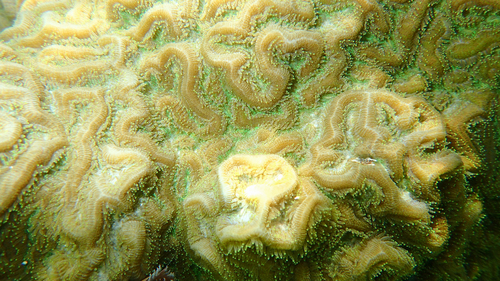
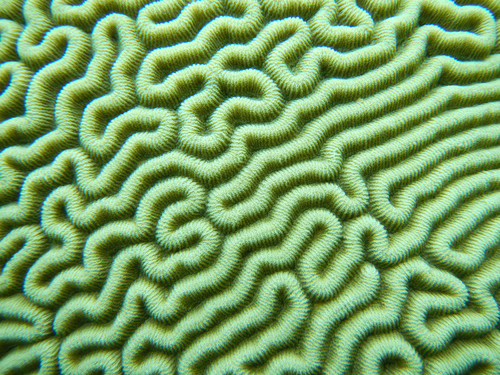
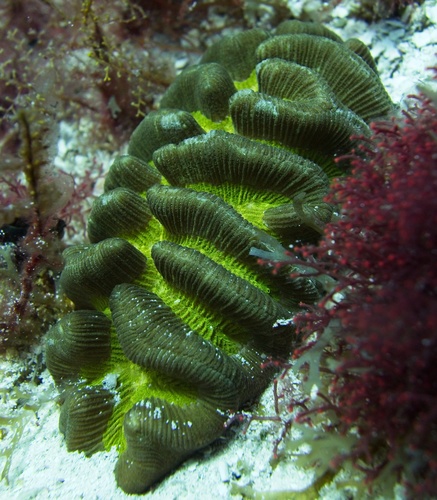
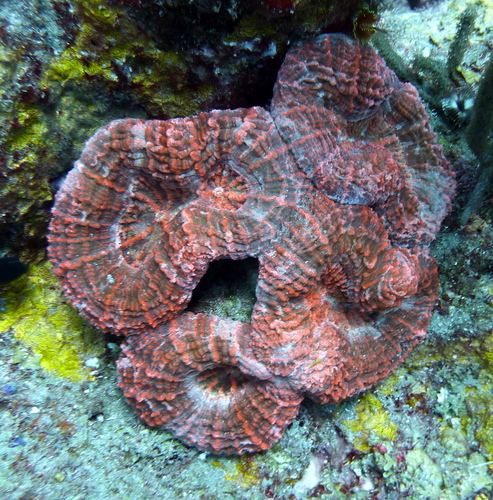
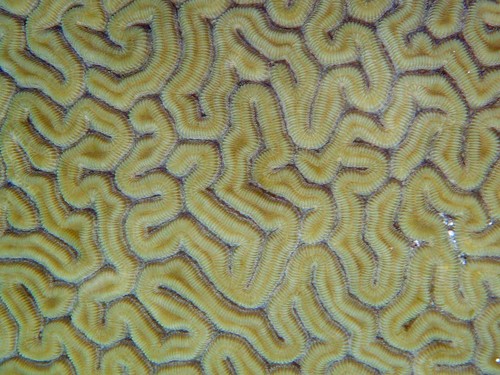
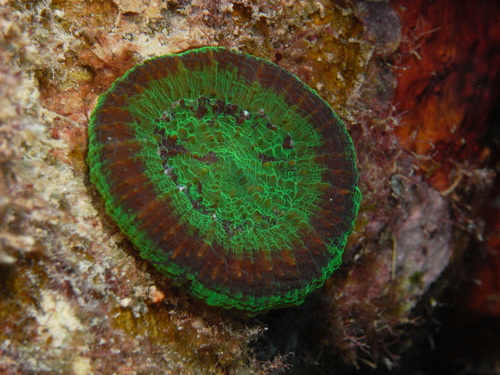
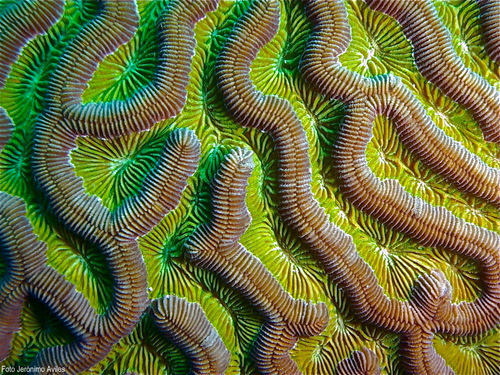
Individual colonies of Colpophyllia natans are large and usually broadly domed; their curvature typically increases as the colony grows larger and older. Colpophyllia natans colonies can grow up to 2 metres (6 ft 7 in) in diameter, which gives the species its common name "boulder brain coral". Young colonies may occasionally form flat-topped discs instead of domes. As a brain coral, its skeleton surface forms a network of winding, curving valleys and ridges that resembles the folded structure of a mammal's cerebrum. Ridge and valley colour varies between colonies: ridges are usually different shades of brown, while valleys are whitish, green, or tan. A single thin groove runs along the top of each ridge. Both ridges and valleys can be up to 2 centimetres (0.8 in) wide; this broader width distinguishes Colpophyllia natans from the similar-looking genus Diploria, which has narrower ridges and valleys. The polyps of Colpophyllia natans only extend their tentacles at night. The robust shape, large size, and slow growth of boulder brain coral help it survive harsh conditions that kill smaller, more fragile corals like the plate-like lettuce coral Agaricia agaricites. Colpophyllia natans and the sympatric, similarly named boulder star coral Montastraea annularis are less likely to be smothered by algal blooms, and both survived the reef-damaging Hurricane Allen that hit the coast of Jamaica in 1980. Caribbean corals are susceptible to coral bleaching caused by high water temperatures and solar radiation. A nine-month study conducted in 2005 compared bleaching-related mortality between Colpophyllia natans and Porites porites, a coral with a finger-like growth form. While bleaching was equally severe in both species, 56% of studied Porites porites colonies died from bleaching, compared to just 8% mortality among bleaching-affected Colpophyllia natans. However, bleaching triggered widespread outbreaks of White Plague Type II, a coral disease. This brought the total bleaching-related mortality of Colpophyllia natans over the nine-month study period to 42%, which is nearly as high as the mortality rate for Porites porites. Boulder brain corals live on coral reefs in the Caribbean Sea and the Gulf of Mexico, with most populations found off the coasts of Belize, the eastern Yucatán Peninsula, southern Florida, Puerto Rico, the Virgin Islands, and Cuba. Fossil evidence of the species dates back at least to the early Pliocene. Colpophyllia natans is one of the dominant reef-building coral species in the Caribbean region, and is commonly found on shallower reef ledges and slopes. It can occur at depths down to fifty metres, but more often grows closer to the water surface.