About Colotois pennaria (Linnaeus, 1761)
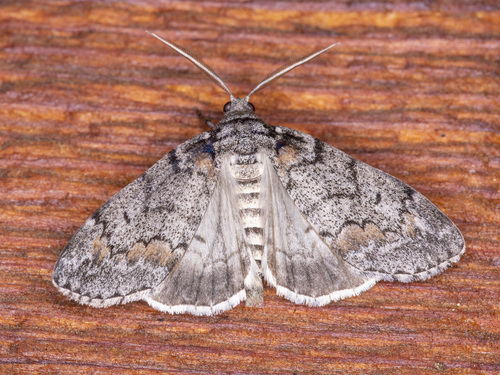
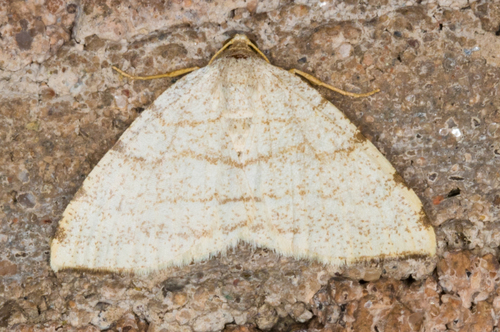
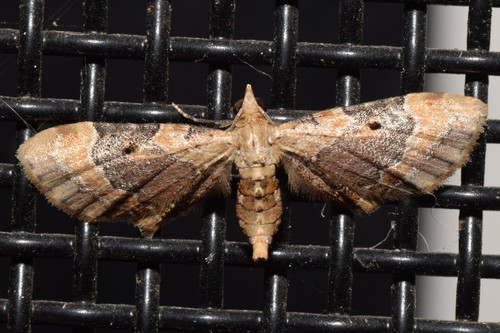
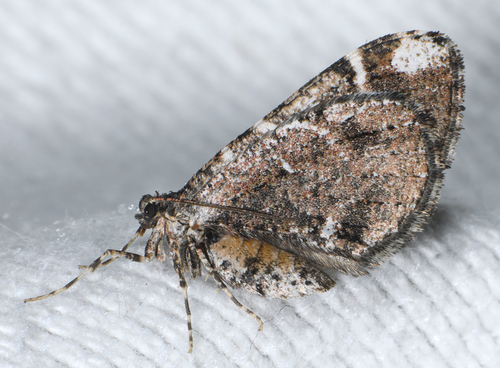
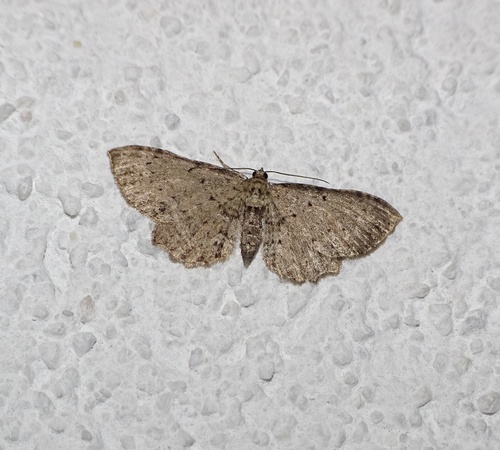
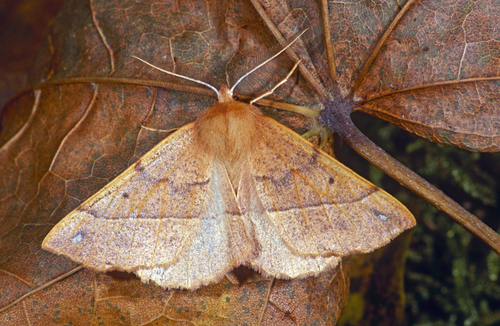
This species, Colotois pennaria, has forewings that are fundamentally brown, but individual moths vary greatly in colour tone, ranging from dull light brown to much deeper reddish shades. The forewings are typically marked with two dark bands and a small discal spot, though these markings can be faint or nearly absent. The hindwings are a lighter, buffish brown. The wingspan ranges from 46 to 50 mm, and males are usually larger with broader wings than females. Females tend to be quite sluggish, while males fly actively at night and are attracted to light. The flight period given is from September to November; this flight season refers specifically to the British Isles, and may differ in other parts of the species' range. Eggs are olive-green, with a ring of pale specks around the micropylar end, laid in clusters on twigs, and overwinter in the egg stage. The hairless caterpillar is brown or purplish grey with ochreous spots and reddish anal points, reaches a length of up to 50 mm, and resembles a small twig. Caterpillars can be found from May to July, feeding mainly at night on a wide variety of trees and shrubs. The species overwinters in the egg stage. It occurs across Europe and the Near East, extending to the Caucasus, and eastwards as far as Sakhalin, Amur, Primorye, Korea, and Japan, where the subspecies ussuriensis is found. It inhabits primarily deciduous and mixed forests, as well as large gardens.