About Colotis phisadia (Godart, 1819)
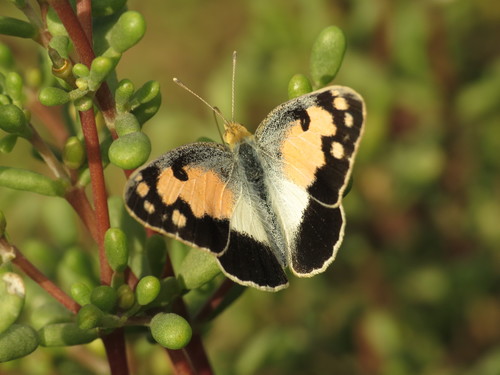
This is a description of Colotis phisadia (Godart, 1819). For males: the upperside of the forewing has a pale salmon-pink ground colour, which is paler toward the outer edge. The base is heavily sprinkled (irrorated) with bluish-grey scales that extend outward and blend into a black patch. This patch occupies the apex of the cell and spreads along the discocellulars. The terminal third of the forewing is black, and encloses spots matching the ground colour in interspaces 3, 4, 5 and 9; the spot in interspace 4 is sometimes absent. The inner edge of the black area is notched (emarginate) at interspaces 2 and 4, and the outer margin has a series of tiny specks of the ground colour in each interspace. The male hindwing is white, with its base heavily irrorated with bluish-grey scales that extend downward in a diffuse band running parallel to the dorsum. The terminal half of the hindwing is jet black. The underside of the male matches the underside of male Colotis protractus, and the antennae, head, thorax, and abdomen are also identical to those of C. protractus.
Females are very variable, and resemble males in overall pattern. On the upperside, the terminal areas of both wings that are black in males are silky brown on the forewing, and the inner curved margin of this area is black toward the posterior. On the female hindwing, the terminal brown area encloses an irregular curved black band that reaches neither the costa nor the dorsum. In some female specimens, the forewing ground colour is faintly pink, fading to white outward; the hindwing ground colour is white, just as in males. In other specimens, the ground colour of both forewings and hindwings is entirely white or pinkish orange. The female underside matches the male underside, but the apical area of the forewing and the entire surface of the hindwing are more or less tinged with ochraceous. This ochraceous tint is very pronounced in many individuals, likely those from dry-season broods. The female forewing has posterior black spots identical to those of the male. The female hindwing has an irregular, curved, spot-like brown discal band that is often underdeveloped (obsolescent). The female antennae, head, thorax, and abdomen are much like those of the male.
Within the region covered by this text, the only recorded occurrences of this species are: six specimens held in the Indian Museum labelled 'Surat'; a single specimen collected at Multan in the Punjab by Dr. Manders; and a record of it occurring in 'Northern India' published by Mabille, for which the author of this description does not know the source of authority.