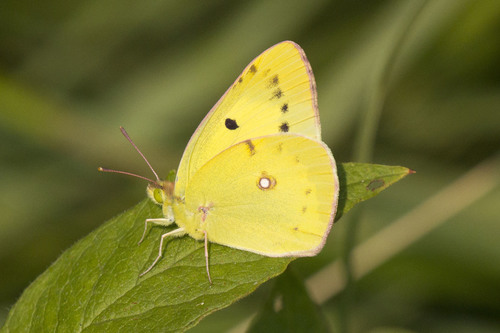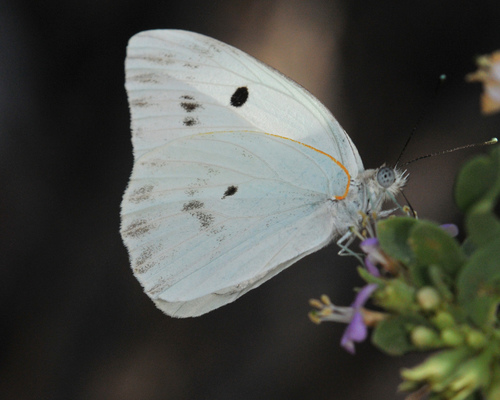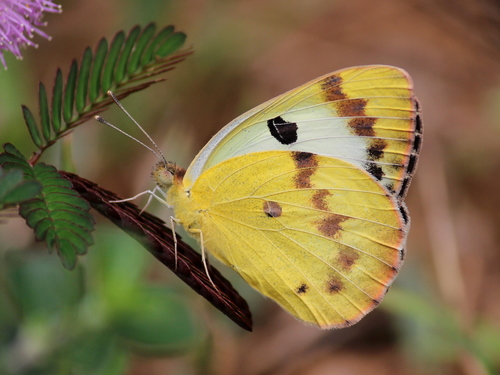
About Colotis fausta (Olivier, 1804)
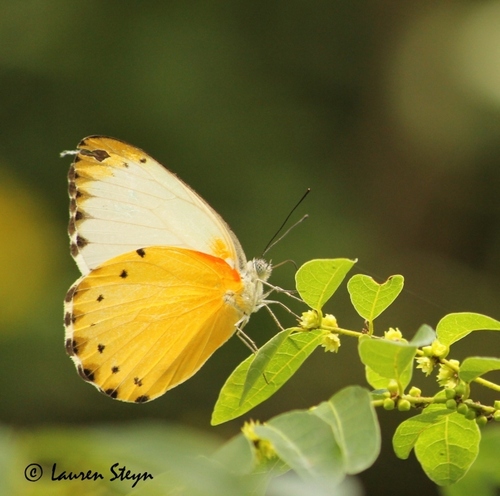
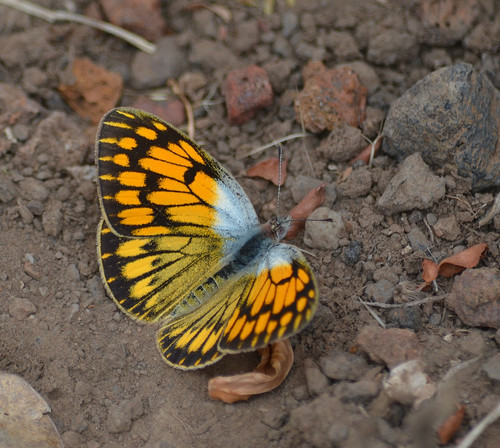
This species has the scientific name Colotis fausta (Olivier, 1804). For males, the ground colour of the wing upperside is pale salmon buff: specimens from desert areas are paler, while those from regions with regular light rainfall are darker. On the forewing, the base and costal margin are speckled with dusky scales to varying degrees; there is a size-variable oval annular discocellular spot, and a black festooned postdiscal band that runs from the costa to vein 4. Beyond this band, the veins are margined with black, and this black colour broadens sub-terminally into a second transverse fascia, which is followed by a very fine black line along the extreme terminal margin. In desert specimens, the transverse bands and black vein edging are narrow, but in specimens from moister areas the two transverse bands unite posteriorly, and along with the slender black terminal line, create an appearance of a double series of spots of the original ground colour enclosed between the bands. The hindwing is more uniform, with terminal black spots on the veins, and a broadly pale costa that fades to white. On the wing underside, the ground colour is pale yellowish white. Many specimens from moist localities are suffused with a distinct rosy flush, and their markings are prominent, while markings are more or less faded in specimens from dry areas. On the forewing, the discocellular spot matches the upperside in placement but is complete rather than an oval ring; some specimens have a narrow, curved postdiscal band of dark ochraceous brown that extends from the costa to the middle of interspace 2. On the hindwing, there is a small discocellular spot shaped like an oval light brown ring, which is always much smaller than the similar spot on the forewing; a postdiscal, curved, more or less sinuate band matches the forewing's band and continues it from the costa to vein 1. The antennae, head, thorax, and abdomen are dusky black. The underside of the antennae club, the hairs covering the head and thorax, and the abdominal scaling are salmon buff; the underside of the body is much paler, fading to white in dry-locality specimens. Males have a sex-mark: a small patch of specialized brown scales on the underside of the forewing, above vein 1, closer to the base than the termen; on the upperside, this appears as a more or less prominent small raised spot. Females are dimorphic. Form 1 females have the same ground colour and markings as males, with the upperside hindwing costa matching the rest of the wing in colour, and naturally no sex-mark. Form 2 females have a white ground colour on the upperside, often with irregular salmon buff suffusion across parts of the wings; markings are similar to males but much broader. On the forewing, the base and costal area are heavily speckled with greyish-blue scales. On the hindwing, the terminal spots at the vein apices are large and quadrate, often merging into a continuous band that encloses an anteciliary series of spots of the original ground colour. A few specimens have faint traces of a postdiscal macular black band, and a very small number have this band almost complete and very prominent. On the underside, the ground colour is white; markings match those of males but are broader, darker, and more prominent. Colotis fausta is found in Baluchistan, Sind, the Punjab, Rajasthan, and Bombay. It also occurs in Asia Minor, Arabia, Persia, and Afghanistan. The race tripuncta (Butler) very closely resembles the typical form of Colotis fausta, but this southern race can be distinguished by the following traits. For male tripuncta, the upperside ground colour is a much deeper shade of salmon buff, almost orange yellow. On the forewing, the costa is heavily speckled with black scales; the discocellular spot is larger and not annular; the postdiscal black fascia is united year-round with the subterminal fascia and black anteciliary line, so that the entire apex and terminal margin of the wing is black, broad at the costa and gradually narrowing toward the tornal angle. This black area never encloses more than three moderately sized preapical spots and a complete series of minute anteciliary specks of the original ground colour. On the hindwing, markings match those of typical C. fausta, but the terminal black spots are very large. On the underside, the ground colour is a richer, yellower tint than the typical form; markings are similar: those on the forewing are dusky black, and those on the hindwing are rose pink. The antennae, head, thorax, abdomen, and sex-mark match those of male typical C. fausta. Female tripuncta closely resemble form 2 C. fausta females on the upperside, but all markings are darker and noticeably broader, and the number of preapical ground colour spots enclosed within the forewing black area is never more than three, matching the male tripuncta. On the underside of the forewing, the ground colour is white, sometimes faintly suffused with yellow; the apical and terminal areas towards the anterior range from light to dark ochraceous yellow; the discocellular spot is very large; the transverse postdiscal macular dark reddish-brown band is very broad. On the hindwing, the ground colour is pale ochraceous yellow, sparsely dusted with black scales; the transverse postdiscal macular band is reddish brown and as broad as that on the forewing. The antennae, head, thorax, and abdomen match those of form 2 C. fausta females. Race tripuncta occurs in western and southern India (Bombay, Poona, the Nilgiris up to 6,000 feet (1,800 m), the Anaimalai Hills), eastern India (Orissa in Bengal, Ganjam), and Ceylon.