About Colotis etrida (Boisduval, 1836)
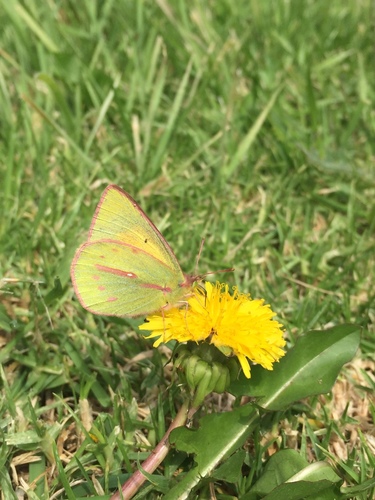
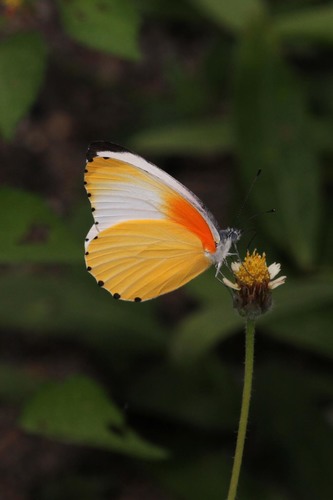
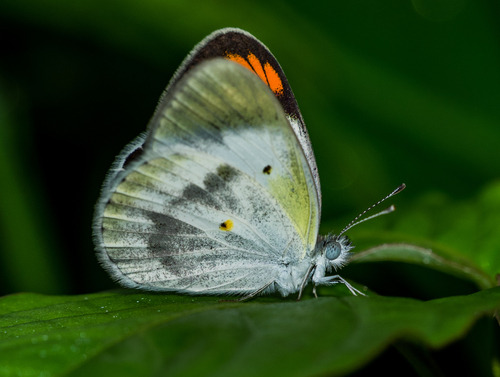
This species has the scientific name Colotis etrida (Boisduval, 1836). For males, the ground color of the wing upperside is white, with sparse black scale speckling at the bases of both the forewings and hindwings. The forewing bears a small black spot on the discocellulars, and has a broadly black apex. Enclosed within this black apex is an oval, curved, rich orange patch placed obliquely; the veins that cross this patch are black, and the inner edge of the entire black apical area is diffuse. The hindwing is mostly uniform, except for a short diffuse preapical black streak extending from the costa (this streak is sometimes absent) and a series of terminal black spots, which are very large in specimens collected from moist localities. The wing underside is white. The cell and apex of the forewing are suffused with sulfur yellow, and the orange patch from the upperside shows through by transparency; the inner edge of this orange patch is margined anteriorly by a very faint oblique fuscous band. The short preapical transverse black streak that appears on the upperside of the hindwing is faintly visible on the underside. Females are very similar to males, but have distinguishing features. On the upperside of the forewing, the orange patch enclosed in the black apical area is narrower; there is an additional small black spot in the middle of interspace 1 and another in interspace 3. The terminal spots on the hindwing are slightly larger than those of males. On the underside, the apex of the forewing and the entire surface of the hindwing are lightly suffused with ochraceous; this suffusion is heavy in specimens from very dry localities. The small black spots in interspaces 1 and 3 of the forewing are present on the underside, matching their placement on the upperside. The hindwing has a curved, almost complete discal series of fuscous spots; aside from these traits, females match males. In both sexes, antennae range in color from white to pale brownish. The head, thorax, and abdomen are black, and the head and thorax are covered in short greyish-brown hairs. On the ventral side, the palpi, thorax, and abdomen are white. This species is found from the outer ranges of the Himalayas across all of peninsular India, with the exception of Bengal. The subspecies C. e. limbata occurs in Sri Lanka. This subspecies has a darker, broader black apical area on the forewing that occupies roughly one third of the wing; the orange patch enclosed within this area is proportionately narrower, which makes the black on the inner margin of the patch appear proportionately broader than it is in the typical form of the species. Very often, this inner edge is bordered by a sulfur yellow suffusion. Specimens collected from the hills of southern India closely resemble this Sri Lankan subspecies.