About Colotis aurora (Cramer, 1780)
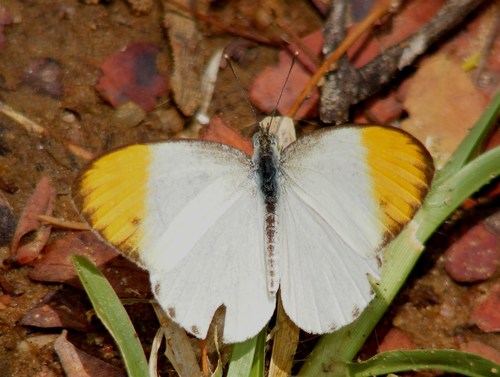
Colotis aurora (Cramer, 1780). Male: The upperside has a pure white base color. On the forewing, the base and costa are speckled with black scales near the base, and a broad apical orange-yellow patch is present. The inner edge of this patch is straight and bordered with gamboge yellow. The patch sometimes has no speckles, but often carries a diffuse black spot on its lower inner edge that may or may not reach the termen below the orange area. Beyond the orange patch, the costa, apex, and termen (extending nearly to the tornus) are edged and festoons with black. On the male's hindwing, black spots of varying size sit at the apices of veins that end at the termen, and a diffuse preapical black spot is present on the costa. Most specimens have a pure white underside, which is suffused with pinkish yellow everywhere except on the disc of the forewing. The base of the forewing is suffused with pure sulphur yellow. The apical orange patch and black terminal markings from the forewing's upperside show through by transparency, and the orange patch is crossed by a sinuous fuscous band that ends in a diffuse black spot. The hindwing has ochraceous shading at its base, a fuscous preapical spot on the costa, plus a small number of scattered transverse fuscous striations and small spots. In many specimens, the preapical spot extends as an obscure fuscous band across the wing, and a series of large terminal fuscous spots is present that aligns with the black spots on the upperside. Both the forewing and hindwing have black discocellular dots. The antennae, head, thorax, and abdomen are black. The antennae are speckled with white on the sides; the head and thorax are covered in short greyish-brown hairs. On the underside, the palpi, thorax, and abdomen are white. Female: The base ground color matches that of the male, but markings differ in the following ways. On the upperside forewing, the base and costa are more heavily covered with greyish-black scales, the discocellular spot is larger, and the apical area is black with three enclosed elongate orange spots. The inner margin of the black area is irregularly sinuate and diffuse, and extends a short distance inwards in interspace 3, with a transverse black spot across the middle of interspace 1. On the upperside hindwing, the base is sprinkled with greyish-black scales more sparsely than the forewing. The preapical costa spot and terminal spots are much larger, and a few specimens have an obscure transverse posterior discal fascia. On the underside, markings follow the same pattern as the male but are much broader, more heavily marked, and more prominent, with more numerous transverse fuscous stripes and dots. The antennae, head, thorax, and abdomen match the male's coloration and structure.