About Colotis amata (Fabricius, 1775)
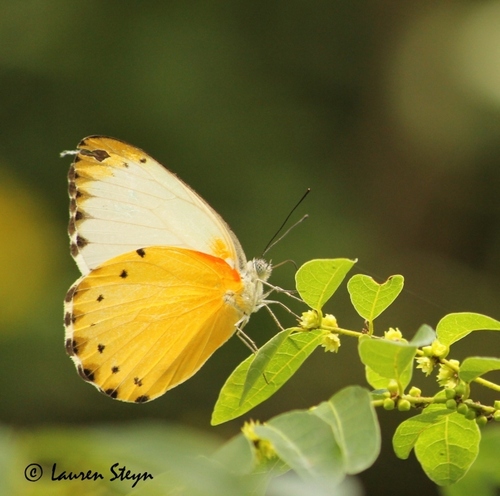
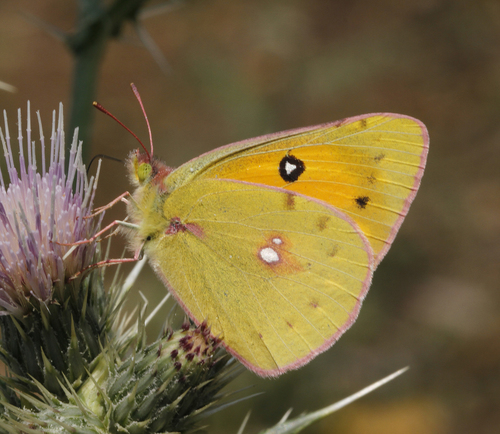
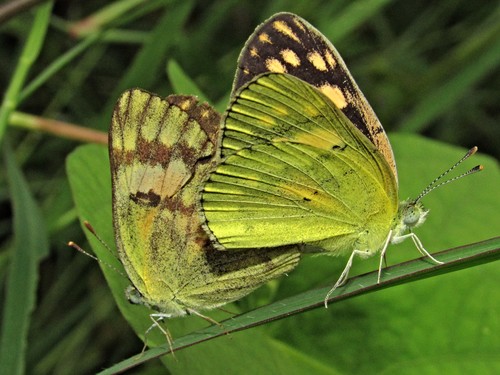
On the upperside of male Colotis amata, the base color is salmon-pink. The costa of the forewing is black and thickly covered with greyish or pinkish scales. There is a black spot at the apex of the cell, which can be large and quadrate, or smaller and lunate. The termen is broadly black, and encloses a double transverse series of spots that match the ground color. The inner series has one large spot in interspace 1, two very small spots (one each) in interspaces 2 and 3, and four larger anterior spots arranged in a curve. Spots in the outer series vary in number, but typically one is present in each interspace, and they are more or less linear in shape. On the male hindwing, a band along the costal margin extends just within the upper margin of the cell, and is covered with dense specialized black scales. This black band connects to a broad terminal band of ordinary black scales, which becomes more or less diffuse and powdery toward the posterior, and encloses a double series of small spots of the ground color. The inner series of these spots is often obsolescent, and entirely absent in some specimens. The dorsum is heavily dusted with fuscous scales, and this dusting extends onto the disc, giving it a generally greyish appearance. On the underside, the base color is greenish yellow. A fine black anteciliary line runs along both the forewing and hindwing, and the black markings from the upperside show through by transparency. On the forewing, a black spot of variable size and intensity sits at the apex of the cell, and is entirely absent in some specimens. There is a subterminal quadrate black spot in interspace 1, and another (sometimes faintly marked or absent) further outward in interspace 2. The disc is faintly pale salmon pink, and the dorsal margin is broadly very pale salmon pink. The entire surface of the hindwing is sparsely dusted with tiny black scales, and has a small black discocellular spot. The cilia of both forewings and hindwings are pale salmon pink. The antennae, head, thorax, and abdomen are black; the antennae are speckled with white, and the head and thorax are covered with greenish-fuscous hairs. On the underside, the palpi are green, and the thorax and abdomen are white. Female Colotis amata are polymorphic. Form 1 females have an upperside with a paler ground color than males, and some specimens are quite ochraceous toward the outer edge. All markings follow the same pattern as males, but are duller in color. Naturally, the hindwing lacks the black costal band of specialized scales found in males, and the ground color extends all the way to the costal margin. The underside is similar to that of males, but the ground color is much paler and more ochraceous than green. In some specimens, an anterior postdiscal curved fuscous band is present, in addition to the black spots in interspaces 1 and 2 on the forewing. On the hindwing of Form 1, the discocellular spot is larger than that of what is referenced as form 3 and forms an annular shape; a curved discal series of reddish spots runs from the costa to the dorsum. Form 2 females are similar to Form 1 females, but their ground color ranges from pale primrose yellow to pure white. In both female forms, the antennae, head, thorax, and abdomen match the appearance seen in males.