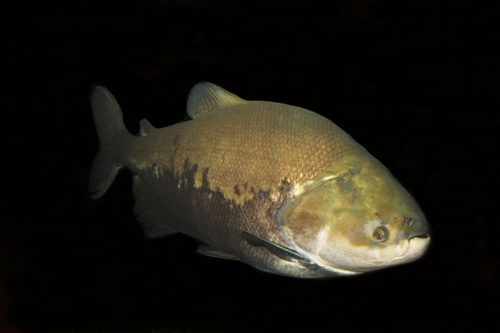
About Colossoma macropomum (Cuvier, 1816)
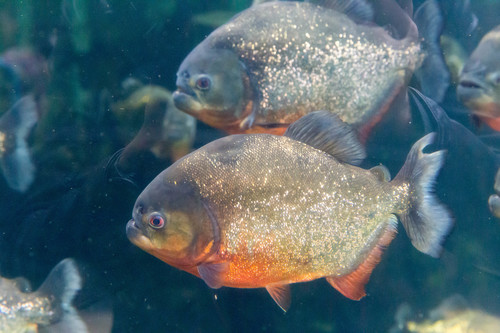
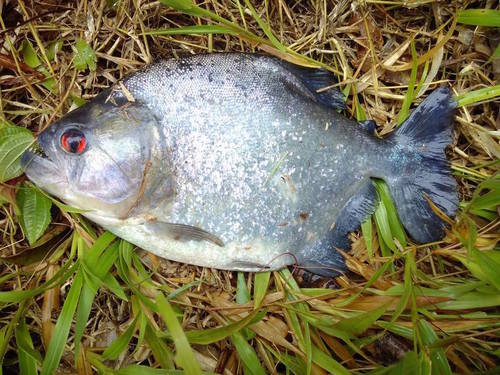
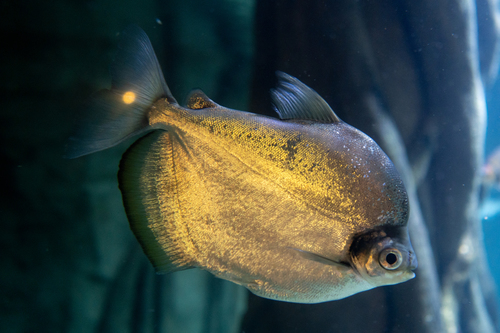
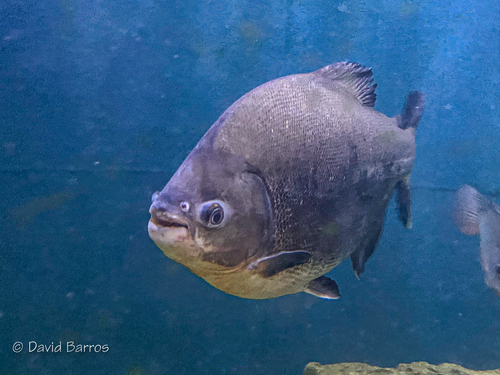
Colossoma macropomum, commonly known as the tambaqui, is the heaviest characin found in the Americas; the related Salminus can grow to a longer total length, but does not reach the same weight. It is the second heaviest scaled freshwater fish in South America, outranked only by the arapaima. The tambaqui can reach a maximum total length of 1.1 m (3.6 ft) and a maximum weight of 44 kg (97 lb 0 oz), but a more typical adult size is 0.7 m (2.3 ft). The largest tambaqui caught by rod-and-reel and recognized by the International Game Fish Association (IGFA) weighed 32.4 kg (71 lb 7 oz), though a 37 kg (81 lb 9 oz) individual caught in Peru in 2013 is recognized by other record-keeping systems. After the annual flood season, visceral fat reserves make up approximately 10% of a tambaqui's weight, with at least another 5% of its total weight consisting of fat stored in the head and muscles. The tambaqui has a similar overall shape to piranhas, and juvenile tambaqui are sometimes mistaken for these carnivorous fish. It is a tall-bodied fish that is laterally compressed, with large eyes and a slightly arched back. Unlike more predatory characins, the tambaqui has molar-like teeth, which are an adaptation for crushing plant seeds and nuts. The lower half of its body is typically primarily blackish. The rest of its body is mainly gray, yellowish, or olive, though exact coloration varies considerably based in part on habitat; individuals from blackwater habitats are much darker than individuals from whitewater habitats. Its pelvic, anal, and small pectoral fins are all black. The tambaqui closely resembles the red-bellied pacu (Piaractus brachypomus), but the red-bellied pacu has a more rounded head profile that is less elongated and less pointed, a smaller rayless adipose fin, and differences in its teeth and operculum compared to the tambaqui. Hybrids between the tambaqui and both species in the genus Piaractus have been produced in aquaculture, and these hybrids are occasionally encountered in the wild. Hybrid offspring can be difficult to identify based on appearance alone. The tambaqui is native to freshwater habitats in the Amazon and Orinoco basins of tropical South America. In nutrient-rich whitewater rivers such as the Madeira, Juruá, Putumayo (Içá), and Purus, the species ranges throughout the entire river, all the way up to their headwaters. In nutrient-poor blackwater rivers such as the Rio Negro, and in clearwater rivers such as several rightbank tributaries of the Madeira, it generally only occurs in the lower roughly 300 km (200 mi) of the river, and is rare beyond the lowermost roughly 150 km (100 mi). It is widely kept in aquaculture outside its native range across South America. Middle Miocene-aged fossils of C. macropomum have been found in northern Colombia and the Peruvian Amazon. The presence of these fossils in Colombia indicates that prior to further uplift of the Andes, the species also inhabited western South America. The fossil range of C. macropomum includes the modern Magdalena River basin, but the species' current occurrence in this basin is the result of human introduction. The tambaqui is mostly solitary, but migrates in large schools. During the non-breeding season, adult tambaqui remain in the flooded forests of whitewater (várzea), clearwater, and blackwater (igapó) rivers. They stay in these flooded forests for four to seven months during the flood season; when water levels drop, they move into main river channels, or to a lesser extent into floodplain lakes. At the start of the next flood season, large schools move into whitewater rivers, where they spawn between November and February. The exact spawning location within these whitewater rivers is not fully confirmed, but spawning is thought to occur along woody shores or grassy levees. After spawning, the schools break up, and the adults return to the flooded forests of white, clear, and blackwater rivers, repeating this annual pattern. Tambaqui larvae are found in whitewater rivers, including the Amazon River itself. Juvenile tambaqui remain near macrophytes in floodplains and flooded forests year-round, and only adopt the adult migration pattern once they reach sexual maturity. Sexual maturity is reached when the fish grows to a length of about 60 cm (2 ft). The species regularly lives to 40 years of age, and may reach up to 65 years.