About Colochirus robustus Östergren, 1898
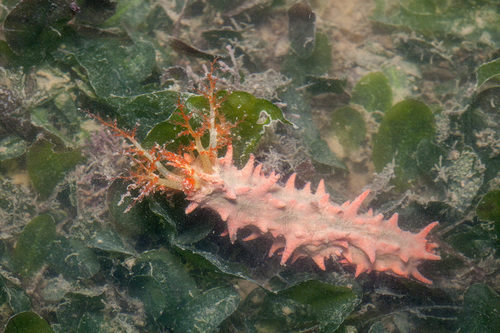
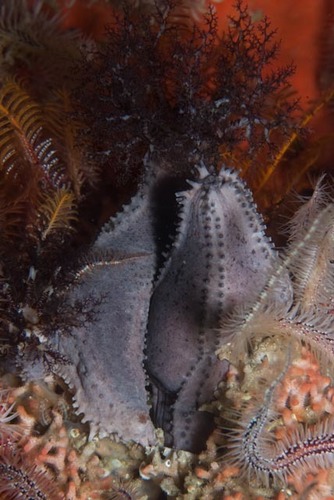
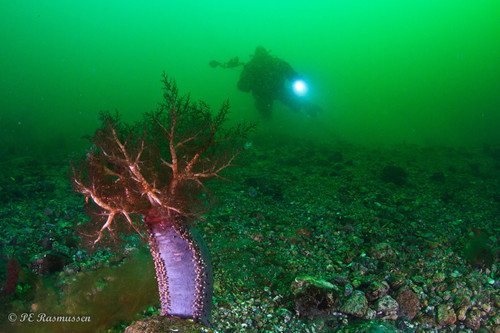
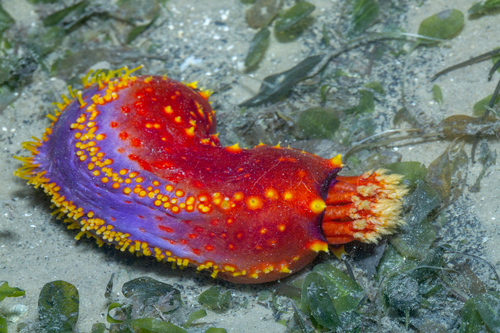
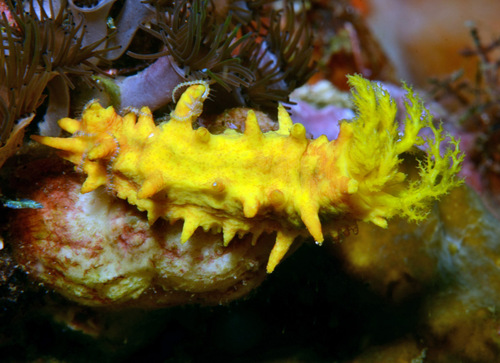
Colochirus robustus Östergren, 1898 has a roughly cylindrical body with five shallow longitudinal ribs, and grows to around 7 centimetres (2.8 inches) in length. It has an angular silhouette, with finger-like or thorn-like protuberances covering the ribs. A ring of around eight large, feathery feeding tentacles sits at its anterior end. A slight transverse indentation is located near its rounded posterior end, and three rows of tube feet run along its underside. Its colour is a vivid yellow, with occasional grey shading between the ribs. This species occurs in the tropical waters of the central Indo-Pacific region, at depths down to roughly 25 metres (82 ft), and its range covers the Philippines and Indonesia. Colochirus robustus typically lives on rocks and reefs in areas with moderate to rapid water flow. It clings to the substrate using its tube feet, and spreads its feathery tentacles to catch zooplankton and other floating organic particles. After capturing food, it retracts its tentacles to the mouth to scrape off the collected particles. Some holothurians reproduce asexually through fission. While fission has been reported as possible for C. robustus, no evidence of asexual reproduction has been found in natural populations. However, asexual reproduction via fission has been observed in C. robustus held in aquarium tanks under poor environmental conditions. It is thought that asexual reproduction does not occur in natural populations because conditions there are not sufficiently stressful, meaning C. robustus can reproduce both sexually and asexually. When asexual fission occurs, a transverse crack develops halfway along the body, gradually widening until the two body halves split apart. The posterior half then grows a new anus, while the anterior half develops a new mouth and new tentacles. Echinoderms can regenerate lost body parts, an ability holothurians use in multiple contexts. Many holothurians, including C. robustus, are capable of regeneration after being cut in half. A 2012 study of holothurians in Nha Trang Bay was the first to find that when C. robustus is cut in half, both the posterior and anterior halves can survive. For the anterior half to regenerate its digestive organ, the gut atrophies up to the esophagus, and a new gut develops from this point. In the posterior half, the gut does not atrophy, but instead becomes thinner and grows forward. Most dendrochirotids are not capable of regenerating both body halves after transection; usually only the anterior half survives, making C. robustus an exception to this pattern. To escape predators, some holothurians can perform evisceration, a process where the gut and other internal organs are suddenly expelled through the mouth or anus. While injection of potassium chloride induces evisceration in many holothurian species, this treatment does not trigger evisceration in C. robustus. Evisceration has been observed in C. robustus held in tanks under poor environmental conditions, and like asexual reproduction, evisceration in this species is thought to be triggered by stressful conditions. Colochirus robustus is sometimes kept in reef aquaria due to its distinctive appearance. It is only recommended for experienced aquarium keepers, however, because it may release toxins into the water when stressed and has specialized feeding requirements. This species has been used in Eastern medicine for hundreds of years, and recent research suggests that consuming robust sea cucumber can stimulate the immune system. In a 2017 study, Sea Cucumber Peptides (SCP) from C. robustus were orally administered to mice. The tested mice showed significant increases in lymphocyte proliferation, serum albumin levels, and natural killer cell and helper T cell activity, confirming that consuming proteins from this sea cucumber has a positive effect on the mouse immune system. Natural Killer cells are cytotoxic cells that help eliminate tumors and fight infectious diseases. Additionally, C. robustus has been shown to improve wound healing and alleviate arthritis pain, and it contains many vitamins, minerals, and other compounds considered highly beneficial to human health.