About Colocasia esculenta (L.) Schott
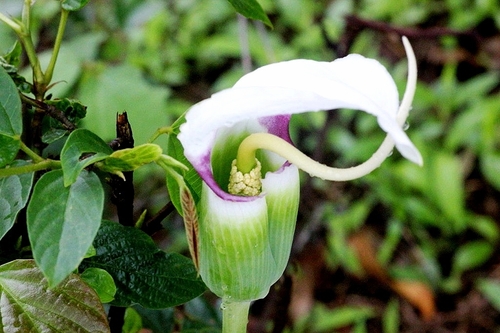
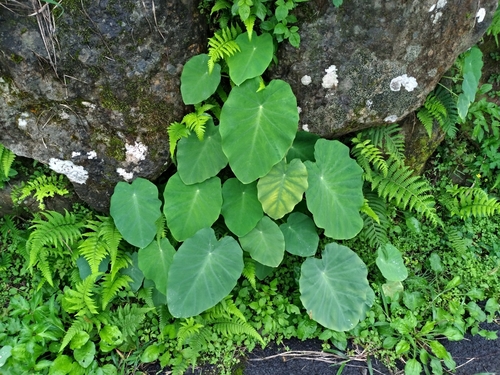
Colocasia esculenta (L.) Schott is a perennial tropical plant, primarily grown as a root vegetable for its edible, starchy corm. It produces rhizomes that vary in shape and size. Leaves grow up to 40 by 25 centimetres (15+1⁄2 by 10 inches) and sprout directly from the rhizome. The upper leaf surface is dark green, while the lower surface is light green. Leaves are triangular-ovate, with a sub-rounded, mucronate apex, and the tips of the basal lobes are rounded or sub-rounded. The leaf petiole reaches 0.8–1.2 metres (2+1⁄2–4 feet) in height, and the peduncle can grow up to 25 cm (10 in) long. The spadix is approximately three-fifths as long as the spathe, with its flowering parts reaching up to 8 millimetres (3⁄8 in) in diameter. The female portion of the spadix holds fertile ovaries that are intermixed with sterile white ovaries. Neutral flowers grow above the female flowers; they are rhomboid, irregularly lobed, and have six or eight cells. The spadix appendage is shorter than the male portion of the spadix. Colocasia esculenta is thought to be native to Southern India and Southeast Asia, and is now widely naturalized. The genus Colocasia is thought to have originated in the Indomalayan realm, likely in East India, Nepal, and Bangladesh. It spread through cultivation eastward into Southeast Asia, East Asia and the Pacific Islands; westward to Egypt and the eastern Mediterranean Basin; and then southward and westward from there into East Africa and West Africa, from where it later spread to the Caribbean and the Americas. Taro was probably originally native to the lowland wetlands of Malaysia, where it is called talas. In modern times it is also called keladi Cina, which literally translates to Chinese yam. In Australia, C. esculenta var. aquatilis is thought to be native to the Kimberley region of Western Australia; the common variety C. esculenta var. esculenta is now naturalised and classified as an invasive weed in Western Australia, the Northern Territory, Queensland and New South Wales. In Europe, C. esculenta is cultivated in Cyprus, where it is called Colocasi (Κολοκάσι in Greek) and holds certified Protected Designation of Origin (PDO) status. It also grows on the Greek island of Ikaria, and is recorded as a vital food source for the island during World War II. In Turkey, C. esculenta is locally known as gölevez, and is mainly grown along the Mediterranean coast, including the Alanya district of Antalya Province and the Anamur district of Mersin Province. In Macaronesia, this plant has become naturalized, probably as a result of Portuguese exploration, and is frequently used in Macaronesian cuisine as an important source of carbohydrates. In the southeastern United States, this plant is recognized as an invasive species. Many populations are commonly found growing near drain ditches and bayous in Houston, Texas.