About Colobus angolensis Sclater, 1860
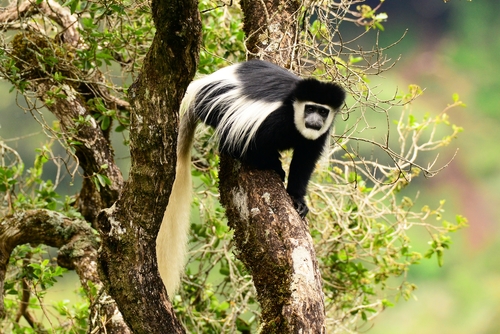
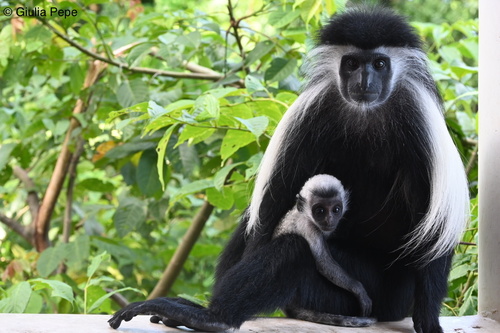
Physical characteristics: Like all black-and-white colobi, the Angola colobus (Colobus angolensis Sclater, 1860) has black fur and a black face, surrounded by long, white locks of hair. It also has a mantle of white hair covering the shoulders. Its long, thin tail may be either black or white, but the tail tip is always white. There is noticeable regional variation in the total amount of white fur on the body and in the length of the fur. Individuals living in mountain regions have longer, thicker fur than lowland individuals, to protect against cold temperatures. The Angola colobus has a head-body length of 50 to 70 cm (20 to 28 in), and males are usually larger than females. The tail is approximately 75 cm (30 in) long, and adult body weight ranges between 9 and 20 kg (20 and 44 lb). Distribution and habitat: The Angola colobus inhabits dense rainforests, in both lowland and coastal mountain regions. It is found across most of the Congo Basin, to the south and northeast of the Congo River, reaching as far as Ruwenzori, Burundi, and southwestern Uganda. The species also occurs in East Africa, particularly in interior and coastal forests of Kenya and Tanzania, and in isolated mountain areas. Despite being named after Angola, the species is quite rare within that country. Among all Colobus species, the Angola colobus occupies the southernmost latitudes, and its geographic range lies entirely south of the range of the mantled guereza. In Kenya, it can be found at elevations up to 2,415 m (7,923 ft) above sea level. Ecology and behaviour: All Colobus species are highly social, and live in groups that can reach several hundred individuals, though most groups are much smaller. The diet of the Angola colobus consists mostly of leaves, with smaller amounts of fruit and seeds also consumed.