About Collybiopsis confluens (Pers.) R.H.Petersen
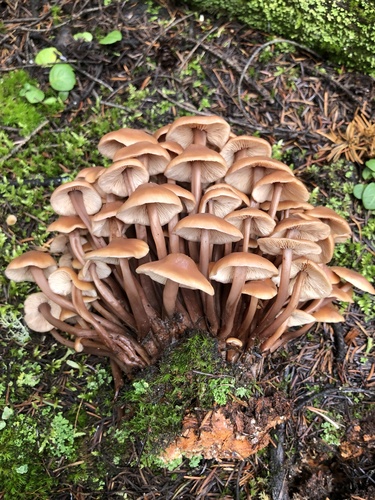
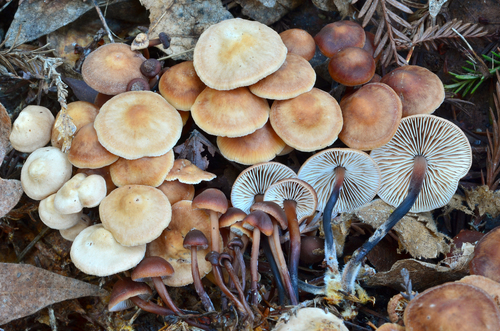
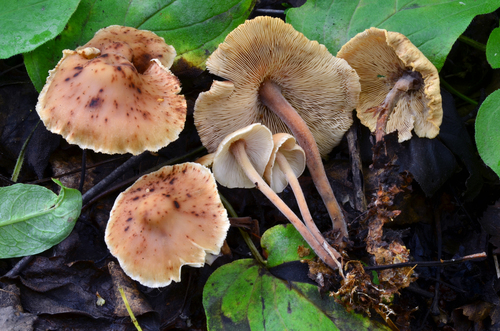
Collybiopsis confluens, commonly known as the clustered toughshank, is a mushroom species belonging to the Omphalotaceae family. Its fruiting bodies develop from summer through autumn in both deciduous and coniferous forests, and this species is not edible. Collybiopsis confluens is widely distributed across Pakistan and the Holarctic realm. Within the Holarctic realm, its range extends from meridional climate zones up to the subarctic climate zone. The species has been recorded in North Asia, including the Caucasus, Eastern Siberia, Kamchatka, China, Korea, and Japan; North America, including the United States and Canada; and Europe. In Europe, it ranges from Spain in the south to Macedonia in the southeast. In western Europe, it can be found in France, Great Britain, the Benelux countries, and northward as far as the Hebrides. It occurs across all of central Europe, eastern Europe, Ukraine, Belarus, and Russia, as well as throughout all of Fennoscandia. In the north, its distribution reaches Sweden and Finland, extending beyond the Arctic Circle. This species grows in almost all native forests and general forest communities, where forests with mature copper beeches are most common. Its fruiting bodies emerge from July to November, most often growing in clustered rows or fairy circles with diameters from 1 to 5 meters. It grows well on substrates from both deciduous and coniferous trees, but occurs most frequently on copper beech wood. It can be found from lowland elevations up to high mountain terrain.