About Collybia cookei (Bres.) J.D.Arnold
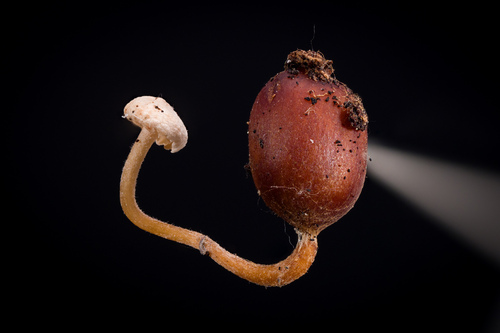
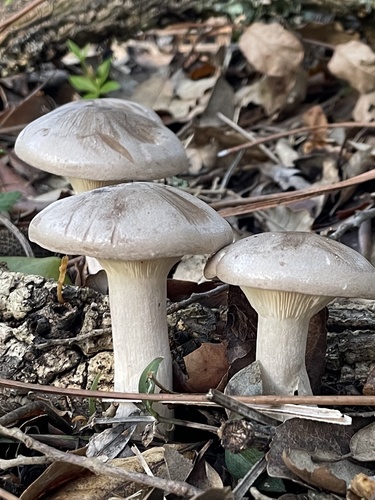
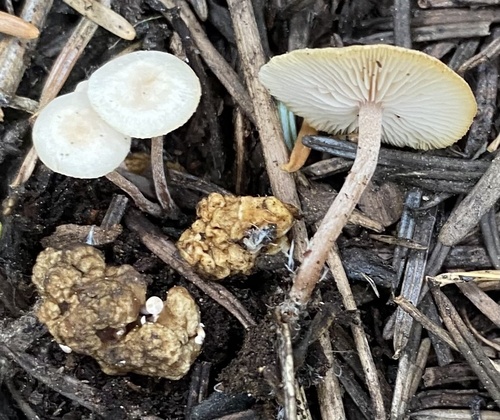
This fungus, known scientifically as Collybia cookei (Bres.) J.D.Arnold, has the following morphological characteristics. Young mushrooms have roughly spherical caps that become convex to flattened as they reach maturity, with cap diameters ranging from 2–9 mm (0.08–0.35 in). When young, the cap margin is rolled or curled inward, and it straightens as the mushroom matures. Cap color ranges from white to cream. The gills are broadly adnate to slightly decurrent, share a similar color to the cap, and are spaced close to subdistant apart. The stem is whitish, consistent in width along its length, usually curved rather than straight, and measures 2–5 cm (0.8–2.0 in) long by 0.3–1.0 mm (0.01–0.04 in) thick. The upper stem surface may be covered in a fine white powdery coating, and thin hairs are present near the stem base. Stems grow from a yellowish-brown sclerotium that can reach up to 6 mm (0.24 in) in length; the sclerotium ranges in shape from roughly spherical to almond-shaped to irregular, and its surface is often wrinkled and pitted. The mushroom has no distinctive odor or taste, and its edibility is unknown. Spore deposits are white. Individual spores are smooth, ellipsoidal to tear-shaped, hyaline (translucent), non-amyloid, and measure 3.9–5.2 by 2.6–3.3 μm. The spore-bearing basidia in the hymenium are four-spored, hyaline, measure 16–20 by 4–5 μm, and have clamps at their bases. No cystidia are present on either the gill edges (cheilocystidia) or gill faces (pleurocystidia). Hyphae in the hymenophoral tissue range from regularly arranged to interwoven. The cap cuticle is a cutis, meaning its hyphae are arranged roughly parallel to the cap surface; it is formed by septate hyphae roughly 4–9 μm in diameter. Clamp connections are present in the hyphae. The sclerotium is made up of hyphae with yellow-pigmented walls that appear pseudoparenchymatous (compactly interwoven short-celled hyphae that resemble parenchyma of higher plants) in cross-section, and these hyphae measure 5–10 μm in diameter. Like all species in the genus Collybia, C. cookei grows on well-rotted, blackened remains of other mushrooms, including species of Russula, Meripilus giganteus, and Inonotus hispidus. Fruit bodies occasionally grow on well-decayed wood or rich humus, and they occur scattered, clustered, or in groups. A field study conducted near a brass mill in Sweden found that heavy metal contamination had little effect on the mushroom's appearance, possibly because its substrate of partially decomposed mushroom fruit bodies has a lower metal concentration than the underlying topsoil. Collybia cookei is distributed across Europe, Asia (Japan), and North America. In Europe, its range extends north to the Arctic Circle and the Lofoten Islands. It is widely distributed across North America, and was first reported in Mexico in 1998. The fungus grows most often in mixed forests dominated by aspen and conifers in montane and subalpine environments. In the Netherlands, it is part of one of three saprobic fungus communities found on roadside verges (the land between a road edge and an adjacent wall, fence, or hedge) planted with common oak (Quercus robur); these verges also support Russula ochroleuca, a common host mushroom for C. cookei.