About Collops vittatus (Say, 1823)
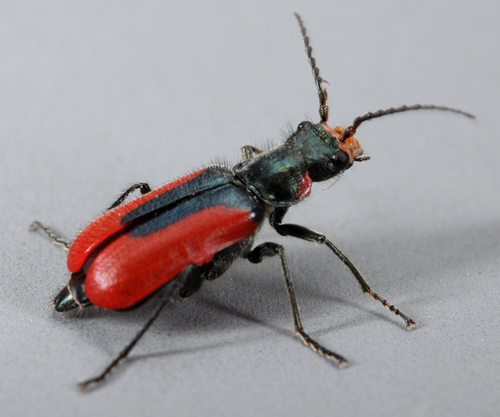
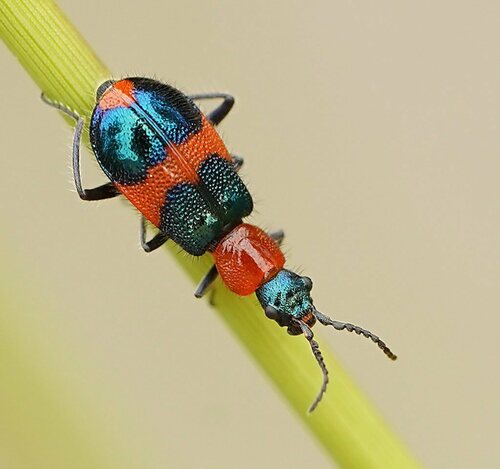
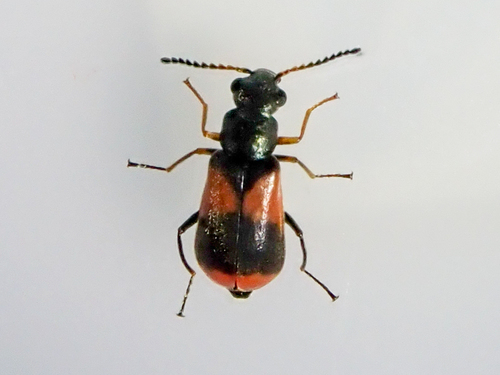
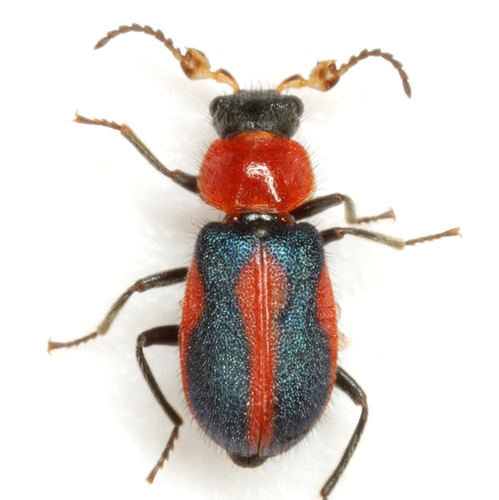
This species is scientifically named Collops vittatus (Say, 1823). Adult Collops vittatus measure approximately 5 millimeters in length. They have a black head, with rufous coloring on the labrum and the base of the antennae. The thorax is rufous, with a central black spot formed from two merged spots that do not reach the front margin. The elytra are greenish-blue, with pale rufous coloring on the always continuous suture, margins, and tips. On the underside of the body, the prosternum is rufous, the postpectus is black, and the abdomen is black with testaceous (dull brick-red) edging along the segmental lines. The legs are mostly black, with brownish coloring on the frontal tibiae. The overall size, shape, and coloration of this species varies by geographic region. The central spot on the thorax may be large, small, divided, or entirely absent. However, the pale margins on the elytra remain fairly consistent across regions. Specimens collected from the northeastern United States tend to be smaller, shiny, have coarser punctuation, darker antennae, and almost entirely black legs. In contrast, specimens from the southwestern United States are larger, less shiny and more dull, have more finely punctured exteriors, pale antennae, and mostly pale legs. Intermediate forms of the species are found in the Dakotas, Montana, Colorado, Texas, and Arizona, which makes it nearly impossible to define clear-cut separate varieties. Males can be distinguished by an enlarged, irregular second antennal segment. The first antennal segment is somewhat triangular, about one-third longer than it is wide, not indented at the back, and flattened at the front. The second antennal segment is narrower than is typical, as long as it is wide, and has a short appendage. In North America, Collops vittatus is distributed across the southwestern United States, extending north into Canada from Saskatchewan to Quebec, and south to the northeastern United States. This range is not always continuous, and the species is not common throughout the entire area.