About Collinsonia canadensis L.
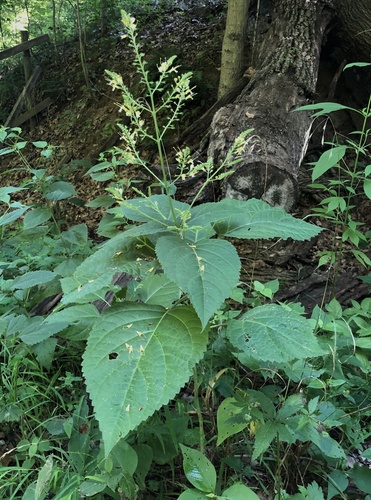
Collinsonia canadensis, commonly known as richweed or stoneroot, is a species of perennial herb in the mint family. It is native to eastern North America, found primarily and widely distributed east of the Mississippi River. It is the most broadly distributed member of the genus Collinsonia, with a range that extends north to Quebec and south to Florida. Its natural habitat is nutrient-rich mesic forests, and it grows most often in rocky, calcareous areas. This species can grow up to 4 feet (1.2 m) tall, and produces terminal clusters of tiny, tubular yellow flowers. Its leaves are green, large, sharply toothed, and ovate. Its flowers are lemon-scented, and bloom in mid-summer, a period when few other plants bloom in densely shaded forests.
Native Americans traditionally used Collinsonia canadensis to treat a variety of ailments. After their initial discovery of the plant, European-American settlers in North America did not often use this species, because it lacked any conspicuous qualities, either toxic or non-toxic. It did not regain popularity as a medicinal herb until the mid-1800s. The leaves of this plant can be brewed into tea, and its subterranean stem was historically used as a diuretic, tonic, and astringent.