About Colletes validus Cresson, 1868
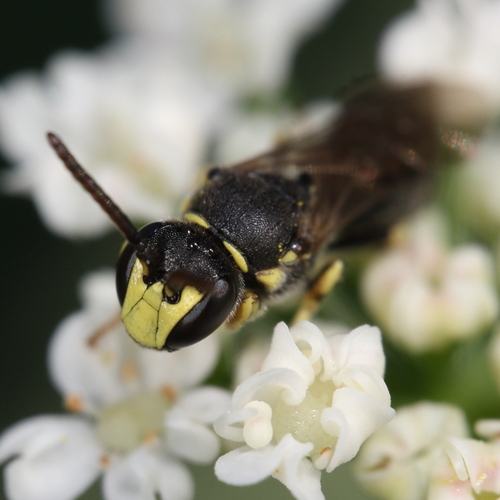
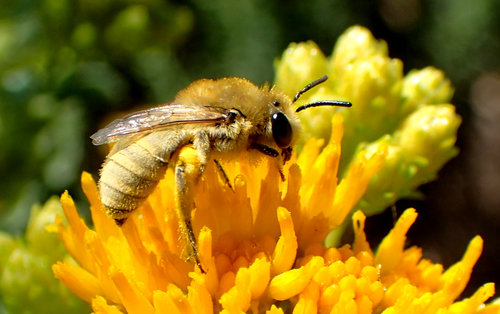
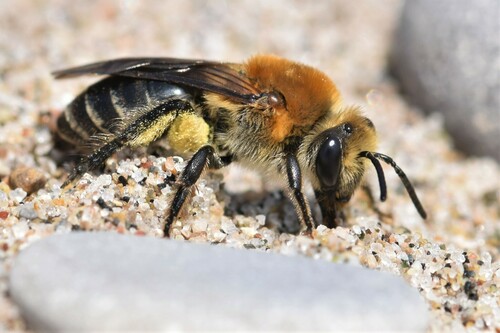
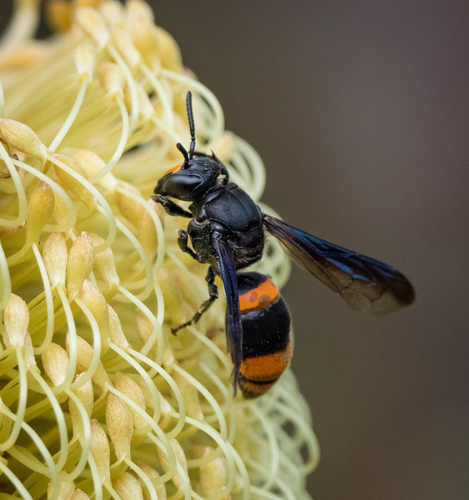
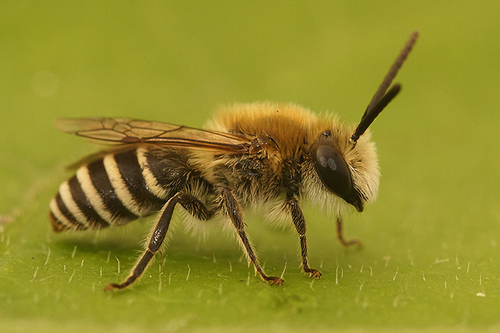
Colletes validus Cresson, 1868, is a medium-sized cellophane bee. Females measure 13–14 mm (0.51–0.55 in) in length, while males measure 10–12 mm (0.39–0.47 in) in length. Like all species in the genus Colletes, every individual of this species has an S-shaped second recurrent vein on the forewing. Most distinctively, both male and female C. validus have an extended malar space, which creates the appearance of a long, triangular face. Within its geographic range, these two traits are diagnostic for identifying C. validus. Males are densely covered in brown-yellow hairs, which gives newly emerged individuals a golden tint. Females are less hairy, and have reduced but still present scopa on their hind legs. C. validus resembles Colletes inaequalis Say and Colletes thoracicus Smith in appearance, range, and phenology, but both of these species do not have the distinctive long face seen in C. validus.
The distribution of C. validus extends from Mid-Atlantic United States north to New Hampshire, and west to Michigan. Sparse records place it as far west as Wisconsin and as far north as Ontario, Canada. Across this entire range, the species occurs in sandy areas near ericaceous plants. Existing records from Georgia and Florida most likely belong to the newly described species Colletes ultravalidus, not C. validus.
C. validus is a gregarious nester, so its nests often occur in dense aggregations of approximately 5 nests per square meter. Nesting sites are located in open sandy soils with sparse vegetation, and these sites are typically positioned close to the species' ericaceous host plants. Nests can be found on flat ground or south-facing slopes, but are rarely found under closed tree canopies, as C. validus prefers warm soils. Dense grass prevents the species from nesting in an area. Surprisingly, C. validus is completely absent from survey data for lowbush blueberry fields in Maine, even though host plants are extremely abundant there and the generalist congener C. inaequalis is present. One proposed explanation is that cold springtime soils discourage nesting, but this hypothesis has not been rigorously tested. This makes it clear that other factors, beyond the presence of open sandy soil and host plants, determine where C. validus nests within its range.
C. validus is a univoltine bee that is active as an adult in early spring, and its flight period coincides with the flowering of Vaccinium and other ericaceous plants. Near the southern edge of its range, adults are active starting in late March; further north, the flight period begins three to four weeks later. Males emerge precociously, a few days before females, and they patrol nesting aggregations to search for mates. They locate females using pheromones, and mating occurs at the nest site. After emerging, females begin excavating their nests, and can use their own emergence burrow as the starting section of their nest. A high rate of natal philopatry, meaning adults return to nest in their birth place, is common for aggregating bees like C. validus. If females emerge too early before their pollen host plants have begun flowering, they can wait for flowering to start by resting at their nest entrance and feeding on nectar from available flowers of other plant species. Males leave the nesting aggregation two to three weeks after they emerge, leaving females as the only flying adult C. validus late in the season. Nest construction and provisioning takes between four and six weeks total, and each individual nest takes between five and ten days to complete.
Nests develop underground through the end of summer: eggs hatch into larvae, larvae feed and grow on the semi-liquid food provisions left by the parent bee, and finally larvae pupate into mature adults. Anecdotal evidence from nests excavated in early March suggests that some fully developed prepupal larvae enter diapause before pupating. It remains unknown whether these prepupae ever complete development, and it is also unknown what factors trigger diapause initiation.
The potential of C. validus to act as a commercial blueberry pollinator has been noted, but this potential has never been fully studied. C. validus has many traits that would make it suitable for commercial management as a pollinator: it prefers blueberry flowers, its annual activity period almost entirely overlaps with blueberry bloom time, and it is able to extract pollen from deep, goblet-shaped blueberry flowers. Learning how to attract wild C. validus to form nesting aggregations and initiate nesting would be a useful first step toward establishing reliable blueberry pollination services on commercial farms.