About Colletes succinctus (Linnaeus, 1758)
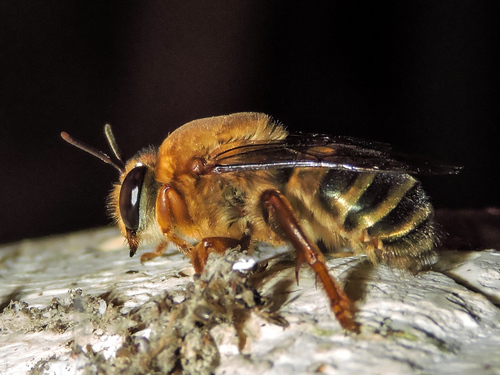
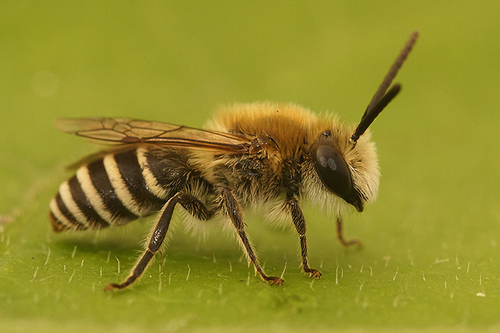
Colletes succinctus (Linnaeus, 1758) is a medium-sized bee that reaches 10 millimeters in length. It has pale hairs on its clypeus, pale transverse bands on the thorax, and an orange, transparent band on the first tergite. This species is similar to two rare related species: the ivy bee (C. hederae), which was separated from C. succinctus as a distinct species in 1993, and the sea aster mining bee (C. halophilus), which was split from C. succinctus in 1943. All three species can be distinguished from one another by their ecology. C. succinctus has a widespread distribution, ranging from southern Ireland and Portugal east through Europe into Asia, extending south to Iran and as far east as Tibet. In Britain, it is widespread as far north as Orkney. It becomes more localized in the southern part of its range, where it is replaced by other closely related species; for example, it is absent from North Africa, where it appears to be replaced by Colletes intricans, another member of the succinctus species group. In Britain, C. succinctus occurs on heathland and moorland. In the rest of Europe, it is also found in these habitats, with additional populations occurring in maritime dunes and on beaches.