About Colletes cunicularius (Linnaeus, 1761)
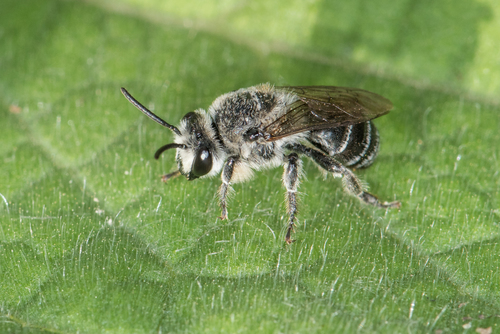
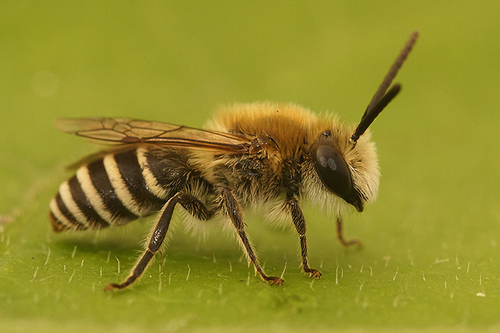
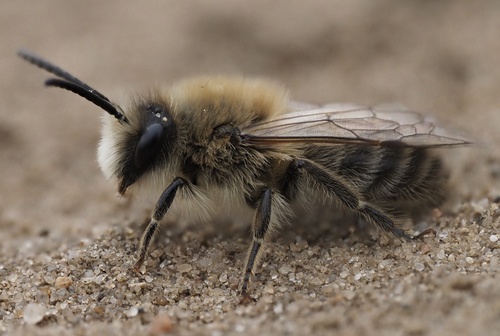
Colletes cunicularius is a large bee species in the Colletes genus. It has an unbanded, hairy, black abdomen that contrasts with its thorax, which is covered in brown hair. Males are smaller and paler than females. In Britain, the species it is most easily confused with is Andrena scotica, which also has an early flight period. C. cunicularius is larger than A. scotica, has longer antennae, and lacks a fovea on the face.
This species is widespread across the Palearctic, ranging from Great Britain in the west to the Pacific coasts of Siberia and China in the east. In Great Britain, it was originally restricted to western coastal areas between south Wales and Cumbria, but has been expanding its range inland. As of 2015, it had recently colonized the island of Jersey from the nearby European continent; the continent may also be the source of C. cunicularius that have begun breeding in southern England.
C. cunicularius is associated with sparsely vegetated sandy areas. In Britain, it was historically associated with large, mature coastal sand dunes located near growths of creeping willow (Salix repens). Bees of this species in Europe are more often associated with alluvial areas where periodic flooding has removed most vegetation. In both Britain and continental Europe, this species has colonized man-made habitats such as sand pits. The British population was originally restricted to dune areas, where it nests in erosion hollows within old dunes. This species is univoltine, meaning it has one generation per year. Its flight period runs from March to May, sometimes extending into June, which is earlier than most other Colletes species.
C. cunicularius forages from a wide variety of flowers. In Great Britain, the most important floral host is creeping willow, and other Salix species are used if creeping willow is not available. It is much more generalist in its foraging plant selection elsewhere: in Finland it has been reported to mainly specialize on willows, while in Italy it has been recorded specializing in pollinating species in the family Fabaceae. Male C. cunicularius are the only known pollinators of two species of sexually deceptive orchids, Ophrys exaltata and Ophrys arachnitiformis, which mimic female C. cunicularius bees. Males have also been recorded attempting pseudocopulation with other Ophrys species.
To create a nest, the female excavates a slightly sloping tunnel into sand that is approximately 45 to 55 centimetres (18 to 22 inches) in length. A number of side tunnels branch off toward the deepest section of the main tunnel, each ending in a single brood cell. Adult males emerge en masse from the upper brood cells one day before females, normally in the afternoon. Each brood cell is lined with a cellophane-like membrane that is waterproof, has antifungal properties, and is thought to help maintain the appropriate humidity level for developing bee larvae. This membrane is made from a liquid secreted by the bee's Dufour's gland. The female uses her short, two-pronged tongue like a paintbrush to smear the oily secretion across the cell walls, where it dries into the clear membrane. Females often nest together in large, noisy aggregations. When females first emerge from their cells, "mating balls" may form as many males attempt to mate with a single newly emerged female. In Britain, this species has no known parasites. On continental Europe, the cuckoo bee Sphecodes albilabris is a cleptoparasite of this species, and the blister beetle Apalus bimaculatus is also recorded as a nest parasite.