About Colius striatus J.F.Gmelin, 1789
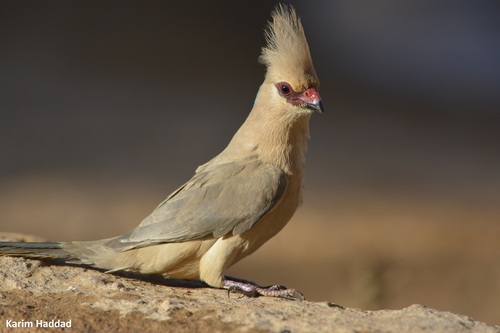
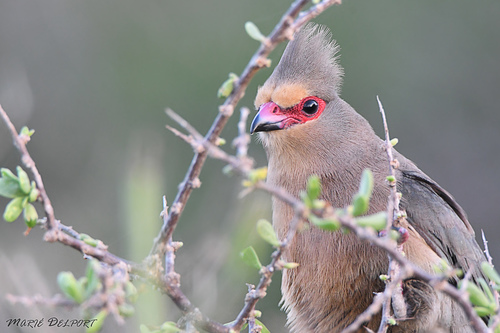
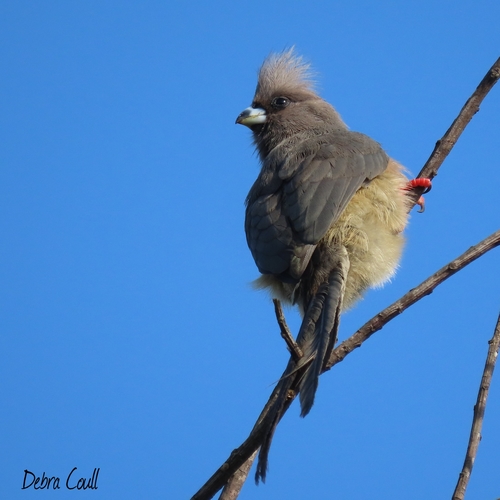
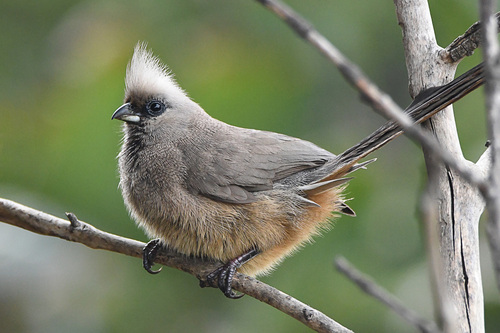
The speckled mousebird (Colius striatus J.F.Gmelin, 1789) measures about 35 cm (14 in) in total length, with the tail making up approximately half of this length, and weighs around 57 g (2.0 oz). Its common name is fitting, as the species has a dull, mousy brown overall coloration on the back and head, which includes a prominent crest. Its upper bill is black, while the lower bill is pinkish. Subspecies of this bird primarily differ in head contrast, throat color, the amount of barring, and iris color. While the rare white-headed mousebird can be confused with this species, the differently colored mandibles and the absence of a bare grey orbital patch make the speckled mousebird distinct. Unlike songbirds, the speckled mousebird is not known for its song, but it is still a noisy bird. It produces a warbling tsu-tsu call during flight, and uses a characteristic tisk-tisk alarm call when flying. This species ranges from Cameroon east to Eritrea and Ethiopia, extending south through eastern Africa to southern South Africa, and is found across all of Tanzania. Most habitats are suitable for the speckled mousebird, with the exception of rainforests and more arid regions. It favors open bushveld habitats, and is also widespread in savanna, open woodlands, and areas with tangled thickets. It is a common backyard bird, frequently seen in urban areas that have gardens and orchards. The speckled mousebird is a distinctly social species. Individuals feed together and perform mutual preening, and they also accompany one another when they go to the ground to dust bathe. They occasionally swallow pebbles to help grind up vegetation during digestion. At nightfall, they roost in very tight groups of around 20 birds, and can enter torpor on cold nights. While being torpid would make them easy prey, their large roost groups are apparently effective enough to deter most nocturnal predators. The speckled mousebird is a frugivore that feeds on fruits, berries, leaves, seeds, and nectar, and it is fairly strict in its food choice across different regions.