About Colius colius (Linnaeus, 1766)
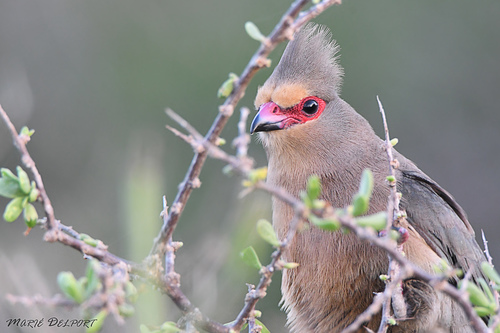
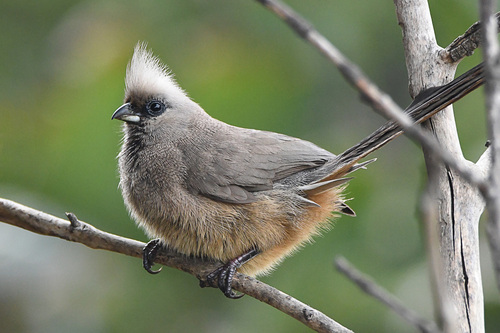
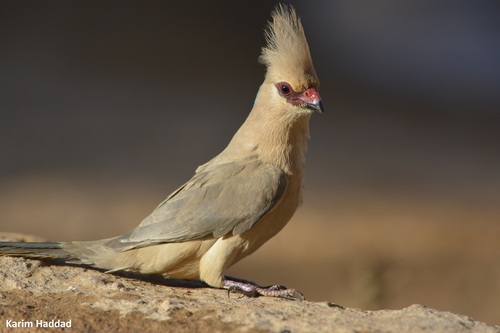
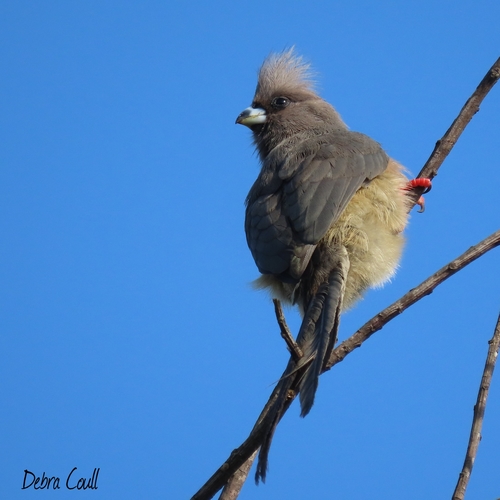
This bird, the white-backed mousebird, has a scientific name of Colius colius (Linnaeus, 1766). It measures about 34 cm (13.5 in) in total length, with its tail making up approximately half of this length, and weighs between 38 and 64 g (1.3–2.3 oz). Its upper parts, head, prominent crest, and breast are grey, with the exception of a white stripe on the back flanked by two broad black stripes, and a dark red or maroon transverse band at the base of the tail. The white back stripe is not visible unless the wings are at least partially open, which typically occurs when the bird is alighting, or sometimes during hot weather. Its belly is buff-colored, its bill is bluish white with a black tip, and its legs and feet are red. This species can be distinguished from the speckled mousebird by differences in the color of its beak, legs, and upperparts. The white-backed mousebird produces a whistled zwee-wewit call, and also has a buzzing or crackling call that may function as an alarm call or to help the group stay in contact. The white-backed mousebird is a frugivore, feeding primarily on fruits, berries, leaves, seeds, and nectar. It also feeds on the buds of some plants, sometimes stripping the branches completely of buds from ornamental plants such as fiddlewoods. Its feeding habits make it unpopular with fruit farmers and home gardeners, which may explain why the species is typically very shy: when it spots a human, it either sits quietly in a tree or flies away immediately. Sometimes, it will settle on lawns when grass is flowering to feed on grass stigmata and stamens. In the wild, its fruit-eating behavior plays an important role in spreading seeds of native berry-producing plants such as Halleria lucida, but it also spreads the seeds of invasive non-native plants such as Cotoneaster. When handling mousebirds, the tail should be avoided, because the long tail feathers (rectrices) come out very easily, which suggests this is a sacrificial defense mechanism. This is a distinctly social species; small groups of likely related birds feed together and engage in mutual preening. They roost in groups at night. Their perching habits are notably parrot-like: they often almost hang from their legs instead of squatting on perches like most birds, and they commonly grip a separate upright branch with each leg. These sedentary birds may breed at any time of year when conditions are favorable. Their nest is a large cup shape, well hidden within a thicket. Both parents feed the nestlings, and helpers, usually young birds from previous clutches, also assist in feeding.