About Colinus virginianus (Linnaeus, 1758)
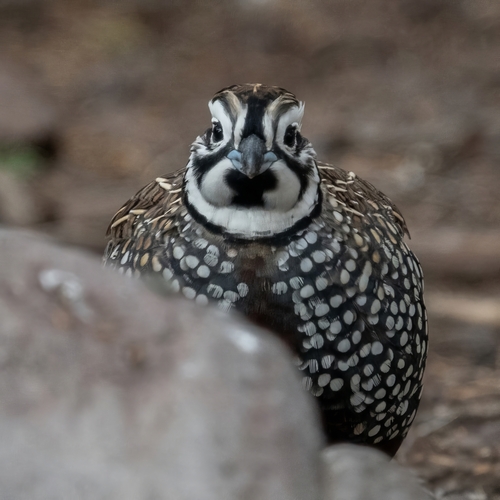
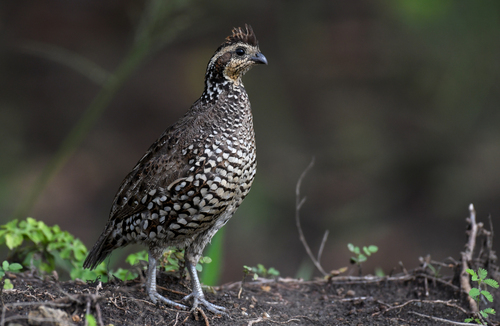
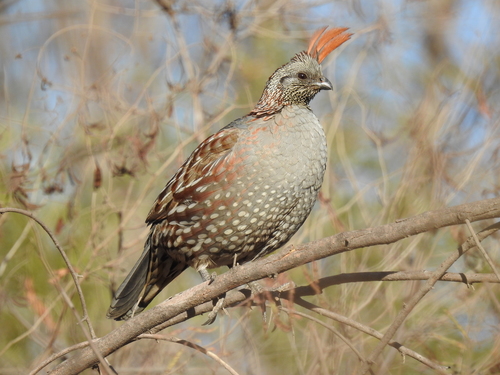
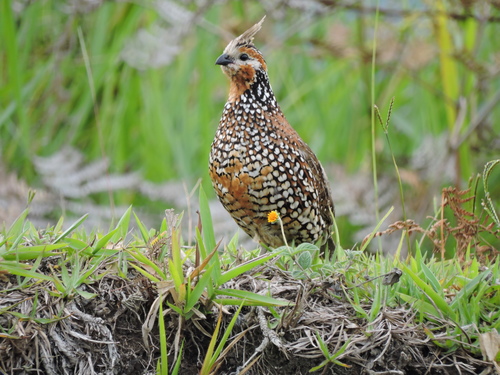
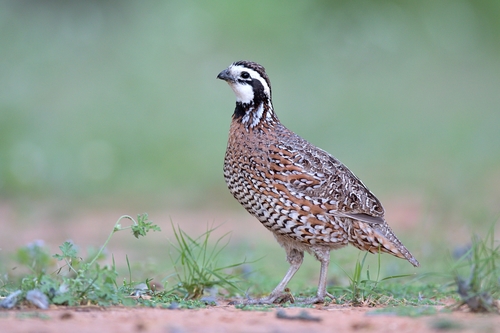
Colinus virginianus, commonly known as the northern bobwhite, is a moderately-sized quail, and the only small galliform native to eastern North America. Adults of this species range from 24 to 28 cm (9.4 to 11.0 in) in length, with a wingspan of 33 to 38 cm (13 to 15 in). Following Bergmann's rule, the body mass of northern bobwhites increases in populations found further north. In Mexico, individuals weigh 129 to 159 g (4.6 to 5.6 oz), while northern populations average 170 to 173 g (6.0 to 6.1 oz), and large males can reach up to 255 g (9.0 oz). Standard measurements for the species are as follows: wing chord measures 9.7 to 11.7 cm (3.8 to 4.6 in), tail measures 5 to 6.8 cm (2.0 to 2.7 in), culmen measures 1.3 to 1.6 cm (0.51 to 0.63 in), and tarsus measures 2.7 to 3.3 cm (1.1 to 1.3 in). Northern bobwhites have the characteristic chunky, rounded body shape of quail. Their bill is short, curved, and colored brown-black. This species exhibits sexual dimorphism. Males have a white throat and brow stripe bordered by black. Their overall plumage is rufous, with gray mottling on the wings, white scalloped stripes on the flanks, black scallops on the whitish underparts, and a gray tail. The species' clear, recognizable whistled call is rendered "bob-WHITE" or "bob-bob-WHITE"; the syllables of this call are slow and widely spaced, rising a full octave in pitch from start to finish. Additional calls made by the bird include lisps, peeps, and faster whistled warning calls. Northern bobwhites reside year-round in agricultural fields, grassland, open woodland areas, roadsides, and wood edges. Their native range covers the southeastern quadrant of the United States, stretching from the Great Lakes and southern Minnesota east to New York State and southern Massachusetts, and extending west to southern Nebraska, Kansas, Oklahoma, the Colorado front-range foothills up to 7,000 feet, and all of Texas except the westernmost portion. They are absent from the southern tip of Florida (where the now extinct Key West bobwhite subspecies once occurred) and the highest elevations of the Appalachian Mountains, and are native to eastern Mexico and Cuba. This species has been introduced to Hispaniola (encompassing both the Dominican Republic and Haiti), the Bahamas, the Turks and Caicos Islands, the U.S. Virgin Islands (where it formerly occurred), Puerto Rico, France, China, Portugal, and Italy. Isolated introduced populations also exist in the U.S. states of Oregon and Washington, and the species has additionally been introduced to New Zealand. No self-sustaining population remains in Pennsylvania, where the species is classified as extirpated; it is also considered extirpated in the U.S. states of New Hampshire and Connecticut. In New York, its distribution is limited to Suffolk and Nassau Counties on Long Island, with possible small population pockets remaining in Upstate New York. Across much of the Northeastern United States, the species is considered either declining or extirpated. In Canada, it is almost entirely extirpated from Ontario (and the country as a whole), with the only confirmed self-sustaining population located on Walpole Island. Like most game birds, the northern bobwhite is shy and elusive. When threatened, it will crouch and freeze, relying on camouflage to avoid detection, but will take low, sudden flight if closely disturbed. Early in the year, it is generally solitary or found in breeding pairs, but family groups are common in late summer, and winter roosts may host coveys of two dozen or more birds. The northern bobwhite's diet is made up of plant material and small invertebrates, including snails, ticks, grasshoppers, beetles, spiders, crickets, and leafhoppers. Consumed plant matter includes seeds, wild berries, partridge peas, and cultivated grains. It forages on the ground in open areas with patches of taller vegetation. Optimal nutrient requirements for northern bobwhites vary by the bird's age and the time of year; for example, the optimal protein requirement for egg-laying hens is 23%, which is much higher than the 16% requirement for males.