About Colibri thalassinus (Swainson, 1827)
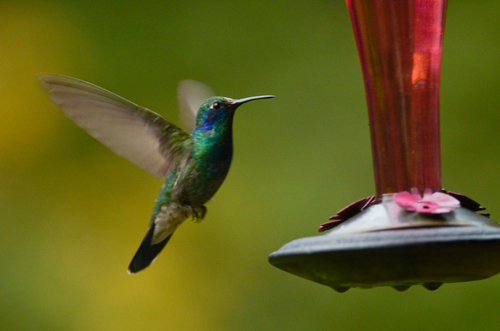
The Mexican violetear (Colibri thalassinus (Swainson, 1827)) is a medium-sized hummingbird. Its total length averages 9.7 to 12 cm (3.8 to 4.7 in), and its wingspan measures 12 cm. It has a mostly straight black bill with a slight downward curve, which is 1.8 to 2.5 cm (0.71 to 0.98 in) long. Body mass ranges from 4.8 to 5.6 g (0.17 to 0.20 oz). Standard measurements note the wing chord is 5.8 to 6.8 cm (2.3 to 2.7 in) and the tail is 3.5 to 4.3 cm (1.4 to 1.7 in).
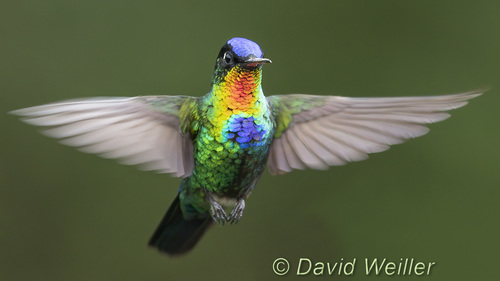
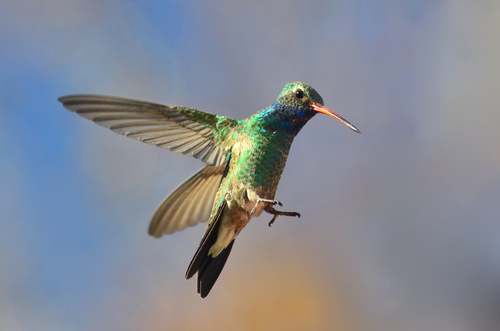
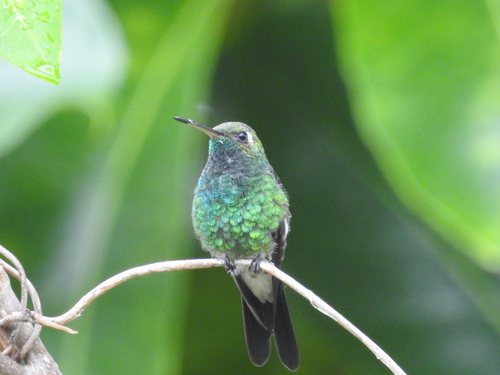
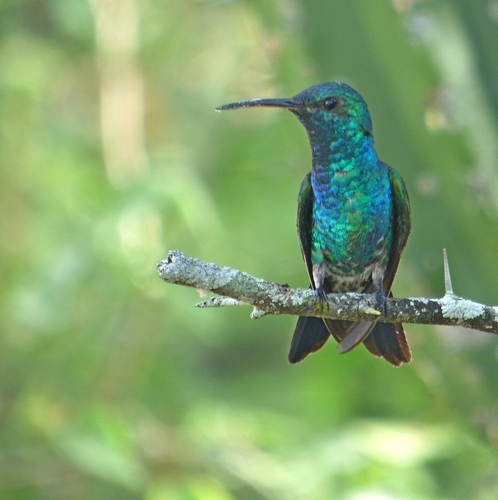
Physically, the Mexican violetear is shining green on its upperparts, with a glittering violet ear-patch on the sides of its neck. Its throat, chest, and belly are all glittering shining green. Its tail is metallic blue-green, with more bronzy central feathers and a prominent black subterminal band.
The Mexican violetear breeds from the highlands of southern Mexico south to Nicaragua. It is a rare but annual nonbreeding visitor to the United States, primarily found in southern and central Texas, with scattered records as far north as extreme southern Canada. According to the IUCN, C. thalassinus can also be found across much of the montane areas of the northern Andes, stretching from Bolivia to Venezuela.
Common habitats for the Mexican violetear include the canopy and borders of subtropical and lower temperate forest, secondary woodland and scrub, and clearings and gardens in the subtropical zone. It is mostly recorded at altitudes between 1,200 to 2,300 m (3,900 to 7,500 ft), though it will sometimes wander as far down as 500 m (1,600 ft) to search for food. It generally prefers more humid, high-altitude areas such as cloud forests.