About Colibri delphinae (R.Lesson, 1839)
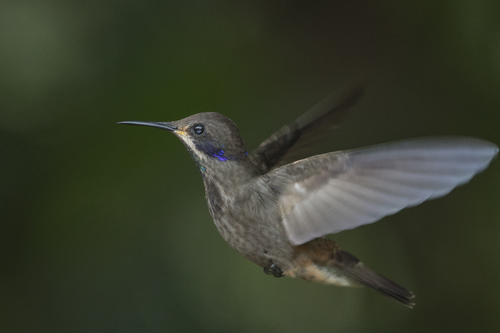
The brown violetear (Colibri delphinae) is a large hummingbird. It breeds at middle elevations in the mountains of Central America, and western and northern South America, primarily the Andes and the tepuis. Isolated populations exist on Trinidad and in Bahia, a state in Brazil. Its breeding habitat is forest at altitudes between 400 and 1600 m, but this species spreads widely into lowlands when it is not nesting. It is replaced at higher altitudes by its relative the lesser violetear (C. cyanotus), but the ranges of the two species overlap widely. The brown violetear is typically found high in the canopy of rainforest, tall second growth, and coffee plantations, but it will feed at lower levels along edges and in clearings. Its nest is a small cup made of plant down, saddled onto a twig 1–3 meters high in a bush. The female lays two white eggs into this nest. This species is 11.5 cm long and weighs 6.5-7 g, and it is an unmistakable hummingbird. It is mainly dull brown, with a rufous rump and greyer underparts. It has a violet patch running back and down from the eye, a hermit-like malar stripe, and a glittering green and blue throat stripe. Its bill is relatively short and almost straight. Females are similar to males, but have a smaller throat patch. Immature birds have rufous fringes on their upperpart plumage, and little to no violet coloring behind the eyes. The song of the brown violetear consists of a vigorous repetition of the chit call. Up to several dozen breeding males sing this song together in loose leks. The brown violetear feeds on nectar from small flowers of trees, shrubs, and epiphytes. It also eats insects, which it often catches in flight through a method called hawking; insects are an essential source of protein for this species. Although the brown violetear is not particularly territorial, it is highly aggressive. At feeding sites, it seems to spend far more time attacking other hummingbirds than it does actually feeding.