About Colias philodice Godart, 1819
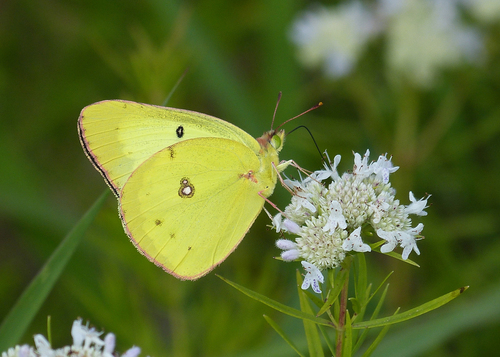
Colias philodice Godart, 1819 is a typical member of its genus. Unlike its close relative the orange sulphur, which can also appear yellowish, both males and females of this species usually have pale yellow upper wings with no orange at all. Males have unmarked clean wing borders, while females have yellow dots within this border area. Females occasionally develop a solid white color morph called alba. The underside of male wings is yellow, while the underside of female wings ranges from yellow to greenish white. Both sexes have a doubled spot on the hindwing, outlined in brownish red. A series of four small red spots runs along the outer third of the hindwing. This trait sets this species apart from most other North American Colias species, such as Colias interior, though the orange sulphur also has these spots. This species has a total wingspan of 32 to 54 mm. The white alba morph can be very common in some populations and rare in others. It is easily confused with white morphs of other Colias species, particularly the white morph of Colias eurytheme. It can usually be distinguished by the border pattern on both wings, though some individuals cannot be told apart without comparing them to other normally colored specimens. Even though their flight styles differ, white Colias philodice can also be confused with other pierid butterflies, including Pieris rapae and Pontia protodice. White alba morph males do exist for this species, but they are extremely uncommon. This butterfly can be found in fields, lawns, alfalfa or clover fields, meadows, and roadsides. Large swarms will gather together at mud puddles. Its range covers most of North America, excluding Labrador, Nunavut, and northern Quebec. This species migrates every year. Females lay pale yellow eggs singly on host plants. After a few days, the eggs turn red, then turn gray just before hatching. Young larvae will cannibalize one another. Mature larvae are green with a white stripe running along each side of the body; these white stripes may hold bars or lines of pink or orange. The green chrysalis hangs upright, secured by a silken girdle. Just before the adult butterfly emerges (a process called eclosion), the chrysalis turns yellow with a pink zipper-shaped marking. When virgin, female Colias philodice can distinguish males of their own species from C. eurytheme males using scent cues. receptive females hold a fixed position and keep their abdomen positioned ventrally between their hindwings; receptivity is confirmed when copulation occurs.