About Colias palaeno (Linnaeus, 1761)
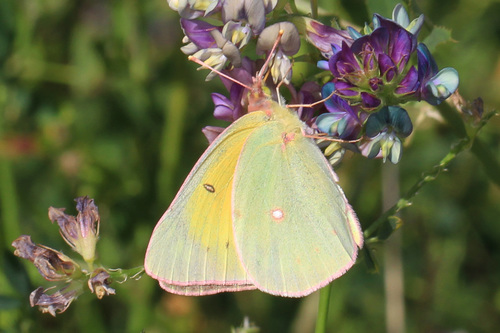
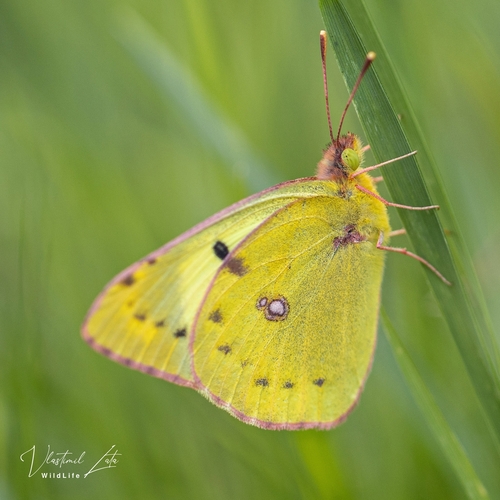
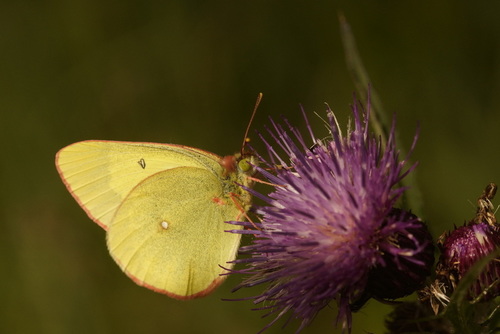
Colias palaeno (Linnaeus, 1761) has a wingspan of 46–50 millimetres (1.8–2.0 in) for males, and 50–52 millimetres (2.0–2.0 in) for females. For males, the upperside of the wings is pale yellow with blackish brown distal margins. The forewing has a dark middle spot with a pale center, and the hindwing has a light middle spot. The wing fringes are red. On the underside, the forewing is pale yellow with a dark middle spot that has a white center, and the costal and distal edges are red. The hindwing is yellow, strongly dusted with fuscous, has a large mother-of-pearl colored middle spot, and red fringes. Females have a white ground color on the upper wing surface. On the underside, the forewing is white near the body and yellow at the apex, and the female's hindwing is somewhat paler than the male's. The larva is velvety sea-green, covered in tiny black dots. It has a bright yellow lateral stripe edged with black below it; under this stripe are white, black-edged spiracles. The underside and abdominal legs are dull green, the thoracic legs are yellowish, and the head is green. The pupa is greenish yellow, with a strongly convex back. This is a Holarctic species, widespread across Asia, Europe, and North America. It occurs in central and northern Europe, ranging from eastern France to the Baltic States, northern Sweden, Norway, and Finland, extending into eastern Europe. It is also found in eastern Siberia, the Chukchi Peninsula, Japan, and northern regions of North America. This species lives in various types of moorland, forest meadows, open coniferous forests, and open areas that may contain scrub. In the southern parts of its range, it is a high alpine species found at elevations over 1,500 metres (4,900 ft) above sea level, but it can also occur on upland bogs around 1,000 metres (3,300 ft) elevation. Though the species is normally restricted to these habitats, it is occasionally found far from suitable breeding grounds.