About Colias fieldii Ménétriès, 1855
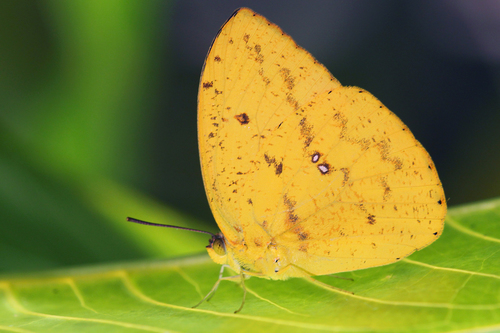
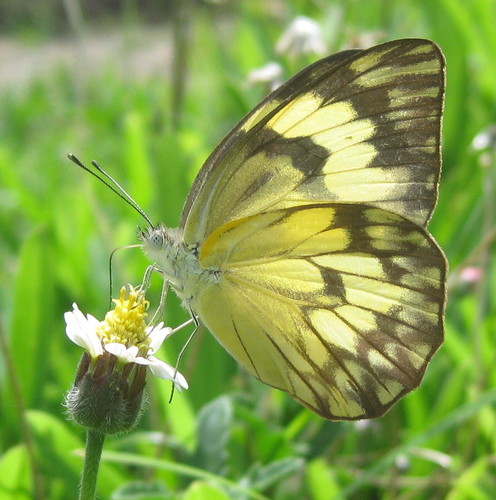
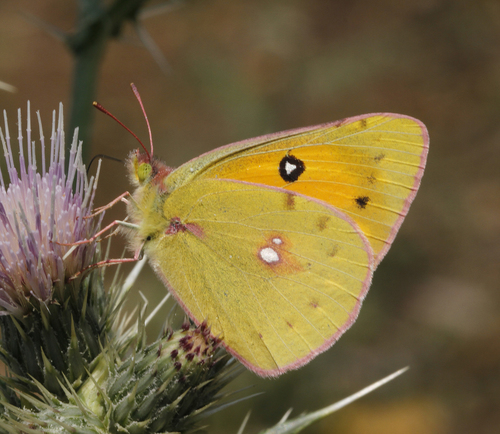
This is a detailed description of Colias fieldii Ménétriès, 1855 (race fieldi, Ménétriés), originally published by Charles Thomas Bingham in 1907, covering male and female morphology, size and distribution. For males: Upperside is deep cadmium orange-yellow. On the fore wing, there is a patch of greenish-black scales at the extreme base, a pear-shaped black spot on the discocellulars, and a broad terminal black border. This black border occupies about a fourth of the wing, its inner margin is slightly curved and irregularly crenulate, and it is broader at the apex and tornus than in the middle. The end portions of veins 6, 7, 9 and 10 are subterminally pale and stand out against the black of the apex. On the hind wing, there is a thin covering of long soft hairs at the base; beneath these hairs, a dusting of black scales extends outwards along the posterior half of the wing. The dorsum is broadly pale yellow, the terminal border is broadly black and broadest in the middle, its inner margin is crenulate, and the discocellular spot is large. The discocellular spot consists of a small patch where the ground colour is paler and brighter, and this patch encloses two somewhat obscure dusky rings, with the upper ring being minute. The cilia of both fore and hind wings are broadly salmon-pink. On the underside, the ground colour is light orange-yellow; the costal margin is narrowly overlaid with pale dull green, the terminal fourth of the fore wing is overlaid with pale dull green, and the entire surface of the hind wing is also overlaid with this colour. The costa, termen and dorsum, along with the cilia of both wings, are salmon-pink. On the fore wing, the discocellular spot matches that on the upperside, but is centred with silvery white; there is a postdiscal transverse series of black spots, which are obsolescent and curved inwards anteriorly, and conspicuous and increasing in size posteriorly. On the hind wing, the discocellular double spot is conspicuously silvery and encircled by a diffuse salmon-pink ring, followed by a very obscure, almost obsolete, transverse postdiscal series of pinkish spots. Antennae, head, and the anterior part of the thorax are salmon-pink; the club of the antennae darkens to brown. The thorax and abdomen are dusky greenish black; on the underside, the palpi, thorax, and abdomen are yellow. A distinct sex-mark is present: a patch of thickly set light yellow scales at the base of interspace 7 on the upperside of the hind wing. Females differ from males in the following traits: On the upperside, the irroration of black scales at the base of the wings is more extensive, especially on the hind wing; the black on the subterminal margins is broader, and its inner edge on both fore and hind wings is more irregular and somewhat diffuse. On the fore wing, the black terminal border is crossed transversely by a series of bright yellow spots: the anterior four are small and obliquely placed, and the posterior one is large. On the hind wing, the discocellular patch lacks the central dark rings that are conspicuous in males, and there is an obscure postdiscal curved transverse series of yellow spots that border the black terminal margin. The underside of females is precisely similar to that of males. The colouration of antennae, head, thorax, and abdomen on the upperside matches that of males, while on the underside the palpi and thorax are more or less salmon-pink. The wingspan of both males and females ranges from 50 to 64 mm (1.98 to 2.5 inches). This species is distributed in the Himalayas from Chitral to Sikhim and Bhutan, at elevations between 2500 and 14,000 feet; its range extends to Assam, Upper Burma, and China.