About Colias eurytheme Boisduval, 1852
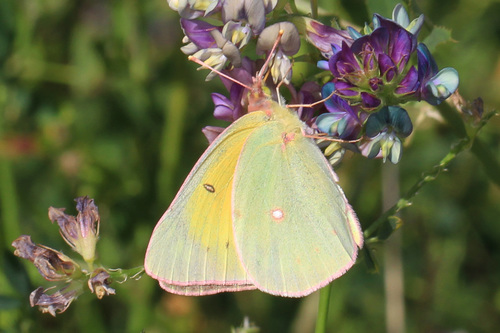
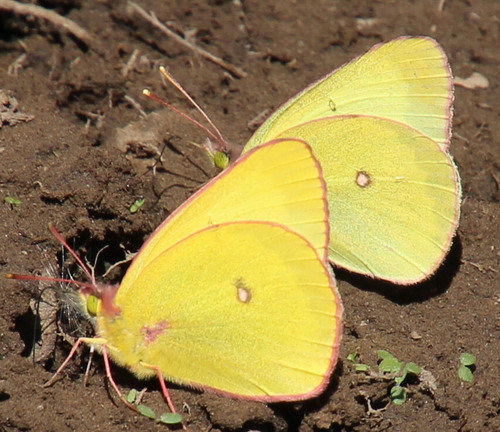
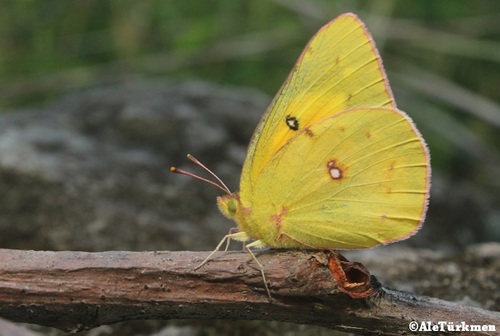
Colias eurytheme, commonly called the orange sulphur, is also known as the alfalfa butterfly; in its larval stage, it is called the alfalfa caterpillar. This butterfly belongs to the family Pieridae, and falls within the lowland group of "clouded yellows and sulphurs" in the subfamily Coliadinae. It occurs across North America, ranging from southern Canada to Mexico. Other close relatives of this species include the common or clouded sulphur (C. philodice), as well as C. eriphyle and C. vitabunda. C. eriphyle and C. vitabunda are often treated as subspecies of C. philodice. Extensive hybridization happens between these related taxa, which makes phylogenetic studies that use only one type of data particularly mtDNA sequences unreliable. Because of this, little is definitively known about the species' exact relationships, other than it may be more closely related to C. (p.) eriphyle than previously assumed. This supports the argument that C. eriphyle should be recognized as a valid species of its own. Orange sulphur caterpillars feed on many species in the pea family, Fabaceae, and they typically only feed during the night. Occasionally, this species grows to very large population sizes, and can become a serious pest of alfalfa (Medicago sativa) crops. The parasitoid wasp Cotesia medicaginis can be used as a biological control agent against these caterpillars. C. eurytheme is distributed from southern Mexico across nearly all of North America. Historically, this species was mostly found in the western Nearctic, but it has expanded eastward due to logging and the planting of alfalfa fields.